
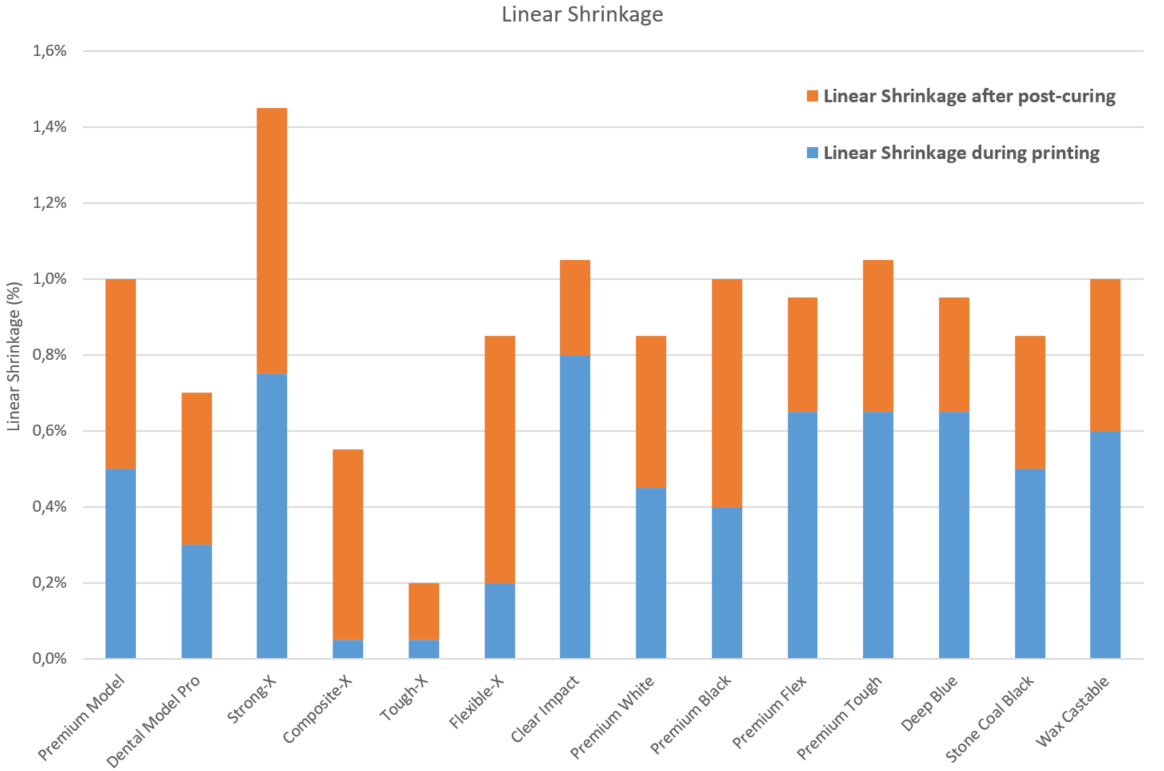
Resin shrinkage is one of the key scientific factors that influences dimensional accuracy in dental 3D printing. During polymerization, liquid resin converts into a solid network, and this process can cause volume reduction. Even small amounts of shrinkage can affect margins, contacts, analog interfaces and overall fit in restorative, orthodontic and implant workflows.
This article explains how resin shrinkage occurs, how it affects dental applications and how labs can control shrinkage through material selection, printer calibration and validated workflows. It is part of the Resin Science and Accuracy structure and supports predictable outcomes across multiple printer platforms.
- What resin shrinkage is and why it occurs
- How shrinkage affects dental model accuracy
- Impact on restorative, orthodontic and implant workflows
- How to control shrinkage with calibration and workflows
- Links to resin, accuracy and workflow documentation
For a complete overview of all dental resins, visit the Dental resins overview. For indication based resin selection, see the Resin Comparison and Buyer Guides.
What is resin shrinkage
Resin shrinkage is the dimensional change that occurs when a photopolymer resin cures under light exposure. As monomers link together into a polymer network, the material can contract. The amount and direction of shrinkage depend on resin formulation, filler content, exposure profile and curing conditions. In dental 3D printing, shrinkage can influence the final size of models, dies and implant interfaces. If not controlled, it may lead to tight or open contacts, margin discrepancies or analog misfit. Understanding shrinkage behavior is therefore essential for accurate dental applications.
How resin shrinkage affects dental model accuracy
Dental models must reproduce intraoral geometry within tight tolerances. Shrinkage can cause small but clinically relevant deviations. The effect is most visible in long span bridges, full arch models and implant verification models.
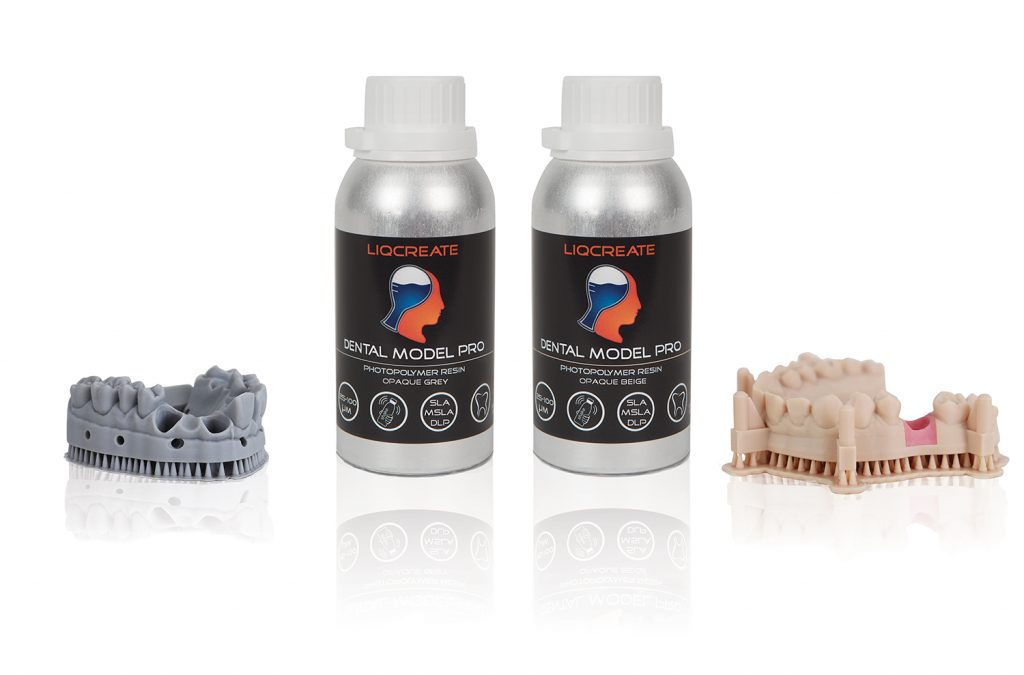
- Model resins are designed to minimize shrinkage and maintain stable dimensions for restorative and orthodontic models. See Best Resin for Dental Models.
- Precision model resins focus on margin clarity and fine detail, where shrinkage control is critical for crown and bridge work. See Best precision model resin for dental labs.
By selecting resins with controlled shrinkage behavior and combining them with validated workflows, labs can reduce dimensional variation and improve fit.
Impact on restorative, orthodontic and implant workflows
Different workflows have different sensitivity to shrinkage. Restorative workflows require accurate margins and contacts. Orthodontic workflows require stable arch forms and predictable thermoforming behavior. Implant workflows require precise analog seating and stable interfaces.
- Restorative workflows: shrinkage can affect margin fit, proximal contacts and occlusal relationships.
- Orthodontic workflows: shrinkage can influence arch width, tooth positioning and aligner fit.
- Implant workflows: shrinkage can impact analog fit, bridge passivity and verification model accuracy.
For broader resin selection per indication, refer to the Resin Comparison and Buyer Guides.
Controlling resin shrinkage with workflows and calibration
Resin shrinkage can be controlled by combining appropriate material selection with printer calibration and validated workflows. Exposure settings, layer thickness, support strategies and curing protocols all influence how shrinkage manifests in the final part.
- Use validated scanning, design, printing and curing workflows from the Dental workflows article.
- Adjust exposure and layer settings based on resin behavior and printer capabilities.
- Ensure consistent washing and post curing to avoid uneven shrinkage.
For resin specific handling and curing parameters, refer to the Dental resin instructions overview.
Role of printer calibration in shrinkage control
Printer calibration is essential for managing shrinkage and overall dimensional accuracy. Correct exposure, uniform light distribution and stable mechanics help ensure that resin cures predictably across the build area.
- Validate accuracy using the Printer Accuracy and Calibration page.
- Confirm resin compatibility and recommended settings for your printer family in the Dental 3D printers overview.
Combining calibrated printers with resins that have controlled shrinkage behavior allows labs to achieve consistent results across multiple indications.
Resin shrinkage is a fundamental factor in dental 3D printing accuracy. It arises from polymerization and can affect margins, contacts, analog interfaces and overall fit. By understanding shrinkage behavior, selecting appropriate resins and using calibrated, validated workflows, dental labs can control dimensional changes and achieve predictable outcomes.
This article is part of the Resin Science and Accuracy structure and connects to the broader resin selection framework within the Resin Comparison and Buyer Guides. For general resin overview, visit the Dental resins overview.
Support
Do you need any help with 3D printing our SLA, DLP or LCD resins? We can help you! Just look for the question you have below. If you can’t find it, let us know by contacting us!
