
The UnionTech Dental Printing Guide provides manufacturer-level insights into UnionTech dental 3D-printer ecosystems, focusing on optical behavior, mechanical stability, resin interaction and dimensional performance when used with Liqcreate dental resins across restorative, orthodontic and appliance workflows.
This article explains how UnionTech printer characteristics influence exposure strategy, calibration routines, accuracy behavior and troubleshooting patterns to support predictable and repeatable dental production.
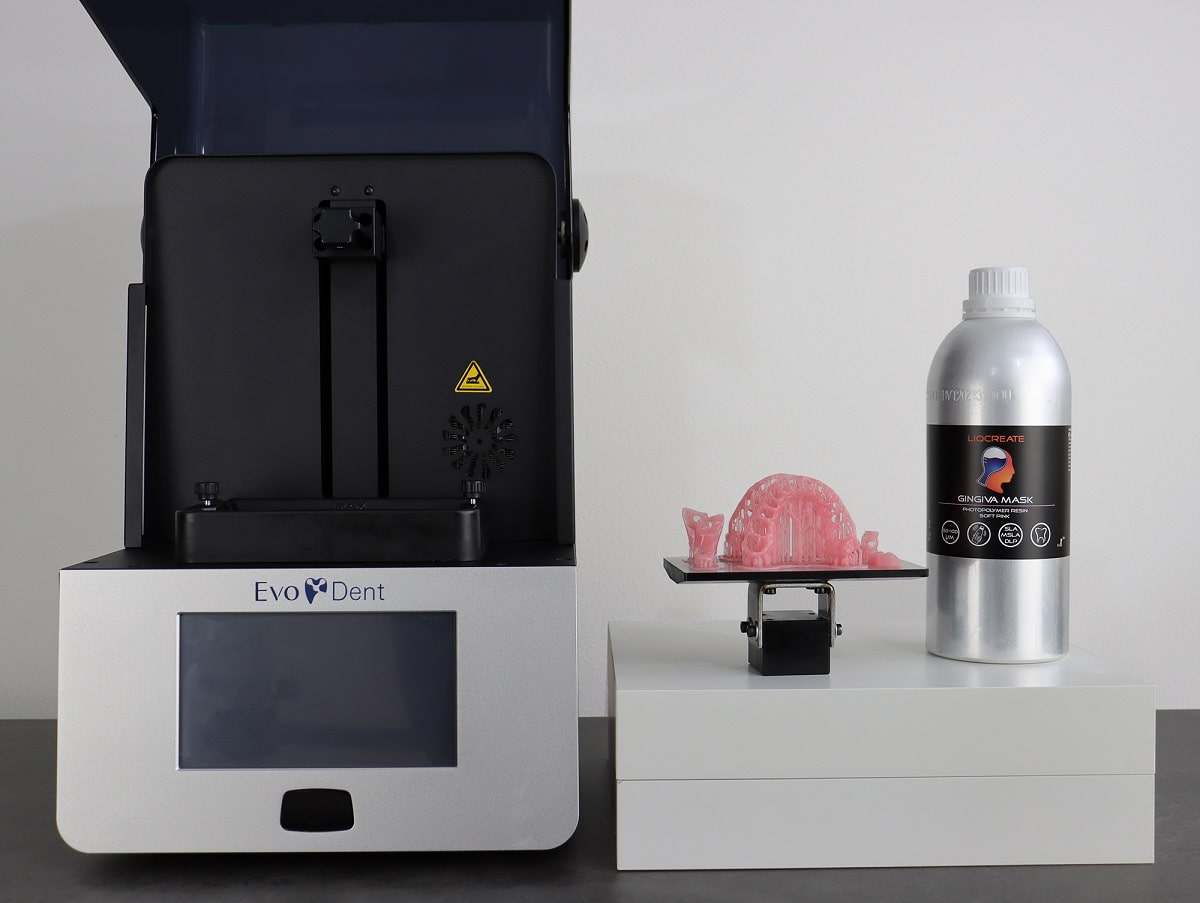
UnionTech brand positioning in dental 3D printing
UnionTech positions itself as an industrial‑grade 3D‑printing manufacturer with a strong engineering heritage, offering stable optical systems, rigid mechanics and consistent exposure delivery across its LCD and DLP platforms. Within dental production, UnionTech provides a multi‑tier ecosystem: UnionTech engineering printers for general‑purpose workflows, Martrix systems for professional laboratory environments and the EvoDent series as the dedicated dental line. This structure allows clinics and labs to scale from compact model production to high‑volume restorative and orthodontic workflows while maintaining predictable dimensional behavior.
UnionTech, Martrix and EvoDent printer lines and Liqcreate compatibility
UnionTech’s dental‑relevant portfolio includes the Martrix series for laboratory‑grade model and appliance production and the EvoDent series as the fully dedicated dental line with optimized software, validated workflows and indication‑specific parameter sets. Engineering‑grade UnionTech and Martrix printers can process Liqcreate Premium Model, Dental Model Pro and other validated dental resins with stable performance when exposure parameters are correctly aligned. The EvoDent series extends this compatibility with dental‑specific calibration routines, workflow automation and resin profiles tailored for restorative, orthodontic and appliance manufacturing, supporting consistent accuracy across daily dental production.
UnionTech dental 3D-printer ecosystem overview
UnionTech dental 3D printers are designed for professional dental environments, combining high-output light engines with rigid mechanical assemblies to produce dental models, aligner bases, splints and indication-specific components. Their ecosystem emphasizes industrial stability, consistent irradiance delivery and controlled motion suitable for high-throughput dental workflows.
The combination of optical uniformity, mechanical rigidity and software-driven control makes UnionTech systems suitable for workflows requiring stable dimensional behavior, provided that resin selection, exposure parameters and calibration routines are aligned with the intended dental indication.
Light engine behavior and optical characteristics
UnionTech printers typically use high-intensity LCD or DLP light engines engineered for uniform irradiance across the build area. Pixel or mirror size, optical path design and panel quality directly influence XY accuracy, edge fidelity and the reproduction of fine anatomical features on dental models and appliances.
Consistent light distribution is essential for predictable cure depth and dimensional stability. Variations caused by LED degradation, optical misalignment or contamination in the light path can lead to localized overcure or undercure, resulting in surface variation, dimensional drift or inconsistent fit across the platform.
Mechanical stability and build platform behavior
UnionTech dental printers rely on reinforced Z-axis assemblies, rigid frames and controlled motion profiles to support stable layer stacking and minimize vibration during printing. Mechanical stability is critical for reducing banding, layer shifts and cumulative Z-error, especially in tall dental models or multi-layer appliances.
Build platform flatness, rigidity and secure mounting influence first-layer adhesion and consistent layer thickness. Any mechanical play, misalignment or contamination on the platform surface can cause adhesion failures, warping or vertical dimensional variation in indications where occlusal detail and vertical accuracy are essential.
Resin interaction and material behavior
Liqcreate dental resins on UnionTech systems exhibit material-specific behavior related to viscosity, reactivity, shrinkage and green strength. Highly reactive materials may require reduced exposure or modified layer strategies to preserve fine detail, while lower reactivity resins may need increased exposure or adjusted base layers to ensure complete polymerization.
Shrinkage during curing and post-curing can influence marginal fit, contact points and overall model dimensions. Following validated exposure and post-curing protocols from the Dental resin instructions hub is essential for maintaining accuracy, surface quality and repeatability.
Exposure strategy for UnionTech dental workflows
Exposure strategies on UnionTech printers differentiate between base layers and normal layers. Base layers use elevated exposure to ensure strong adhesion to the build platform, while normal layers use optimized exposure to balance cure depth, surface quality and dimensional stability.
Lift speeds, retract distances and rest times influence peel forces, resin flow and the ability of the resin to refill the gap between the build platform and the film. For high-detail dental models, thin splints or fine anatomical structures, controlled movement and sufficient rest time help prevent layer separation, distortion, suction-related defects or surface artifacts.
Accuracy behavior and influencing factors
Accuracy on UnionTech dental printers is influenced by light engine resolution, optical uniformity, mechanical stability, resin properties, exposure settings, support strategy and post-processing. XY accuracy is driven by pixel or mirror size and optical quality, while Z accuracy depends on layer thickness control, Z-axis mechanics and cumulative layer behavior.
Resin-specific factors such as shrinkage, green strength and post-cure expansion can affect final dimensions and fit. Using validated settings from the Dental resin instructions hub and indication-appropriate support strategies helps maintain consistent accuracy for dental models, aligner bases, splints and other dental applications.
Calibration routines for stable performance
Regular calibration of UnionTech printers supports stable accuracy and repeatable exposure behavior. This includes build platform leveling, verification of layer thickness, inspection of optical components, checking for uniform light output and ensuring that motion parameters are correctly configured.
Calibration should be combined with periodic test prints and dimensional checks on reference geometries or standardized dental models. Deviations from expected dimensions or recurring artifacts may indicate the need for mechanical inspection, panel or film replacement, optical cleaning or adjustment of exposure parameters, supported by the Printer accuracy and calibration hub.
Troubleshooting patterns for UnionTech dental workflows
Common issues on UnionTech dental workflows include undercure, overcure, surface roughness, layer lines, incomplete features, suction-related defects and dimensional drift. Undercure may present as soft surfaces or poor detail reproduction, while overcure can cause rounded edges, loss of fine anatomy or oversizing of critical dimensions.
Surface artifacts and print failures can result from contaminated resin, worn or damaged films, incorrect support placement, excessive peel forces or non-uniform light output. Systematic troubleshooting includes inspection of mechanical components, verification of resin condition, review of exposure and motion settings and comparison with validated parameters, supported by the Dental 3D-printer troubleshooting hub.
Workflow integration for UnionTech dental 3D-printing
UnionTech dental workflows should be configured in combination with the Dental resin instructions hub, the Dental 3D-printers page, the Printer accuracy and calibration hub and the Dental 3D-printer troubleshooting hub to maintain consistency across indications and printer ecosystems.
By aligning UnionTech printer behavior with validated Liqcreate resin settings, structured calibration routines and documented troubleshooting patterns, labs can build stable, predictable workflows for dental models, aligner production, splints and other dental applications within dental 3D-printing.
Related resources for dental 3D-printers
- Dental 3D-printers page – main hub connecting all dental 3D-printer brands, model pages, accuracy resources and troubleshooting guides.
- Dental resin instructions hub – validated exposure settings, handling notes and material behavior for Liqcreate dental resins.
- Printer accuracy and calibration hub – guidance on accuracy measurement, calibration routines and influencing factors for dental 3D printers.
- Dental 3D-printer troubleshooting hub – structured troubleshooting for exposure issues, surface defects and stability problems across supported printer ecosystems.
Support
Do you need any help with 3D printing our SLA, DLP or LCD resins? We can help you! Just look for the question you have below. If you can’t find it, let us know by contacting us!
