
4K and 9K MSLA displays represent two different resolution classes within the Elegoo Mars‑series. While both provide sufficient detail for general‑purpose resin printing, the higher pixel density of 9K panels reduces pixel size and improves edge definition on small features. However, resolution alone does not determine print quality. Optical uniformity, pixel‑class, irradiance stability and mechanical rigidity all influence how accurately a printer cures each layer.
In the Mars‑series, 4K printers use a standard MSLA optical engine with a larger pixel size, while 9K models combine a higher‑density LCD with improved light distribution. This results in more consistent curing behavior across the build area and better performance in applications requiring fine detail, such as dental models, miniatures and engineering parts with tight tolerances.
The sections below explain the practical differences between 4K and 9K MSLA systems, how they affect curing behavior, and when the higher resolution of a 9K Mars‑printer provides measurable benefits.
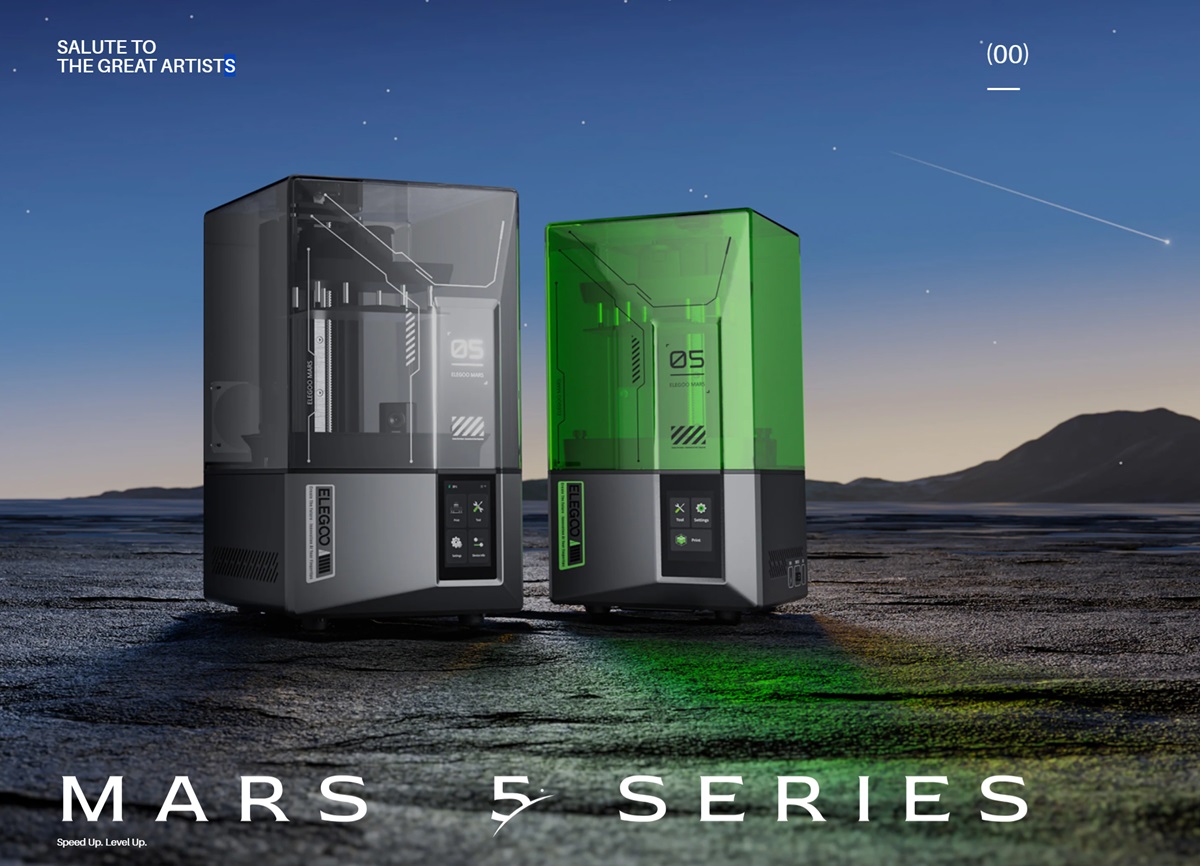
4K vs 9K MSLA in the Elegoo Mars‑series
4K and 9K MSLA displays represent two different resolution classes within the Elegoo Mars‑series. While both provide sufficient detail for general‑purpose resin printing, the higher pixel density of 9K panels reduces pixel size and improves edge definition on small features. However, resolution alone does not determine print quality. Optical uniformity, pixel‑class, irradiance stability and mechanical rigidity all influence how accurately a printer cures each layer.
In the Mars‑series, 4K printers use a standard MSLA optical engine with a larger pixel size, while 9K models combine a higher‑density LCD with improved light distribution. This results in more consistent curing behavior across the build area and better performance in applications requiring fine detail, such as dental models, miniatures and engineering parts with tight tolerances.
The sections below explain the practical differences between 4K and 9K MSLA systems, how they affect curing behavior, and when the higher resolution of a 9K Mars‑printer provides measurable benefits.
What 4K means in MSLA printers
A 4K MSLA panel uses a 3840 × 2400 LCD with a pixel size in the 35–50 µm range, depending on the screen dimensions. In the Elegoo Mars‑series, this resolution class is positioned as the reliable, general‑purpose option. The larger pixel size produces a slightly softer edge profile, but still delivers more than enough detail for functional parts, dental models with moderate requirements and standard tabletop miniatures.
4K printers in the Mars‑series rely on a conventional MSLA backlight system, which provides stable curing behavior across most of the build area. For users who prioritize speed, cost‑efficiency and predictable performance over micro‑detail, 4K remains a strong and capable resolution class.
What 9K means in MSLA printers
A 9K MSLA panel increases the pixel count to 8520 × 4320, reducing pixel size to roughly 18–22 µm. This higher pixel density produces visibly sharper edges, cleaner curves and more accurate reproduction of small features. In the Elegoo Mars‑series, 9K printers also benefit from improved optical uniformity, meaning that irradiance is distributed more evenly across the entire LCD.
This combination of smaller pixels and a more advanced optical engine results in more consistent curing behavior, especially on thin walls, embossed text and fine surface details. For applications where precision matters — such as dental models, miniatures with micro‑features or engineering parts with tight tolerances — the 9K class provides a measurable advantage.
Pixel‑class comparison
The difference between 4K and 9K is not just a matter of resolution; it is a shift in pixel‑class. Smaller pixels reduce aliasing, improve edge definition and allow the printer to cure fine details with greater accuracy. Where a 4K Mars‑printer produces smooth and functional results, a 9K model delivers sharper transitions, cleaner edges and more consistent dimensional accuracy across the build plate.
This improvement becomes especially visible on curved surfaces, small radii, embossed lettering and detailed organic shapes. Even without changing resin or exposure settings, the 9K panel produces a more refined surface finish simply because the pixel grid is finer and the optical system distributes light more evenly.
Optical system differences
Beyond resolution, the optical engine is one of the most important distinctions between the two classes. 4K Mars‑printers use a standard MSLA backlight, which is sufficient for most applications but can show slight variations in irradiance toward the edges of the screen.
9K Mars‑printers typically incorporate improved collimation and higher uniformity lenses. This results in a more stable and evenly distributed light field, reducing over‑cure on edges and improving the accuracy of small internal features. The optical upgrade often has a greater impact on print quality than the resolution increase itself, especially when working with engineering resins that require consistent curing depth.
Impact on curing behavior
Curing behavior is influenced by pixel size, optical uniformity and exposure stability. With a 9K panel, the smaller pixels and improved light distribution create a more predictable curing profile. Thin walls cure more evenly, transitions between features become sharper and the risk of light bleed is reduced.
For dental model resins, miniature resins and engineering materials, this translates into cleaner margins, more accurate fits and reduced post‑processing time. Even when using identical exposure settings, a 9K Mars‑printer typically produces more consistent results across the entire build area.
Impact on dimensional accuracy
Dimensional accuracy benefits directly from smaller pixels and a more uniform optical engine. A 9K Mars‑printer can reproduce small holes, tight tolerances and fine mechanical interfaces with greater precision. XY‑bleed is reduced, and features that would appear slightly rounded or softened on a 4K panel remain crisp on a 9K system.
For users printing functional parts, snap‑fits or components that must interface with other hardware, the 9K class provides a noticeable improvement in repeatability and fit.
Impact on surface quality
Surface quality improves as pixel size decreases. A 9K Mars‑printer produces smoother curved surfaces, reduced pixel stepping and sharper detail transitions. This is particularly visible on miniatures, dental arches, organic shapes and embossed textures.
While anti‑aliasing can soften the pixel grid on 4K printers, it cannot fully compensate for the larger pixel size. The finer pixel grid of a 9K panel inherently produces a cleaner surface finish, even with minimal post‑processing.
When 4K is sufficient
A 4K Mars‑printer is more than adequate for general prototyping, functional engineering parts and dental models that do not require extreme detail. Users who prioritize speed, simplicity and cost‑efficiency will find that 4K delivers consistent and predictable results across a wide range of resins.
For workflows where micro‑detail is not critical, the difference between 4K and 9K is minimal in practice.
When 9K provides measurable benefits
A 9K Mars‑printer becomes valuable when the application demands high detail, sharp edges or tight tolerances. Dental models with defined margins, miniatures with micro‑features and engineering parts requiring precise fits all benefit from the smaller pixel size and improved optical uniformity.
If your workflow includes high‑detail Liqcreate resins, the 9K class consistently delivers cleaner surfaces, more accurate features and reduced finishing time.
Elegoo Mars models using 4K vs 9K
4K Mars‑printers:
- – Mars 3
- – Mars 3 Pro
- – Mars 4 (4K variant)
9K Mars‑printers:
- – Mars 4 Ultra (9K)
- – Mars 5 Ultra (9K class)
FAQ
What is the real difference between 4K and 9K MSLA in the Elegoo Mars‑series? The main difference is pixel‑class. A 4K panel uses larger pixels, while a 9K panel has a much finer pixel grid. This improves edge sharpness, surface quality and dimensional accuracy on detailed prints.
Does a 9K Mars‑printer always produce better results than 4K? Not always. For general prototyping and functional parts, 4K is more than sufficient. The benefits of 9K become visible on small features, curved surfaces and applications requiring high precision.
Is the optical engine more important than the resolution? In many cases, yes. Improved optical uniformity and collimation in 9K Mars‑printers reduce light bleed and create more consistent curing behavior across the build area.
Do 9K printers require different exposure settings? Exposure times are often similar, but 9K printers may benefit from slightly lower exposure due to higher irradiance efficiency. Always check the Elegoo Mars resin settings database for validated parameters.
Which Elegoo Mars models use 4K and which use 9K? 4K includes the Mars 3, Mars 3 Pro and Mars 4 (4K). 9K includes the Mars 4 Ultra and Mars 5 Ultra.
Is 9K worth it for dental models? Yes. Dental arches, margins and fine anatomical details benefit significantly from the smaller pixel size and improved optical uniformity of 9K systems.
Support
Do you need any help with 3D printing our SLA, DLP or LCD resins? We can help you! Just look for the question you have below. If you can’t find it, let us know by contacting us!
