
Warping in dental 3D printed models can compromise accuracy, fit and long term stability. Even when exposure settings and post processing are correct, certain geometries, support strategies and curing conditions can introduce internal stress that leads to deformation. This article explains how to avoid warping in dental models by optimizing design, orientation, support placement and post processing steps.
The guidelines below are based on lab tested behavior of dental model resins and are intended to help dental labs produce stable, dimensionally accurate models for crown and bridge work, implant analogs, aligner production and diagnostic applications.
- Design strategies to reduce internal stress
- Orientation guidelines for stable dental models
- Support placement for balanced structural reinforcement
- Post processing steps that minimize deformation
- Integration with washing, curing and shrinkage compensation
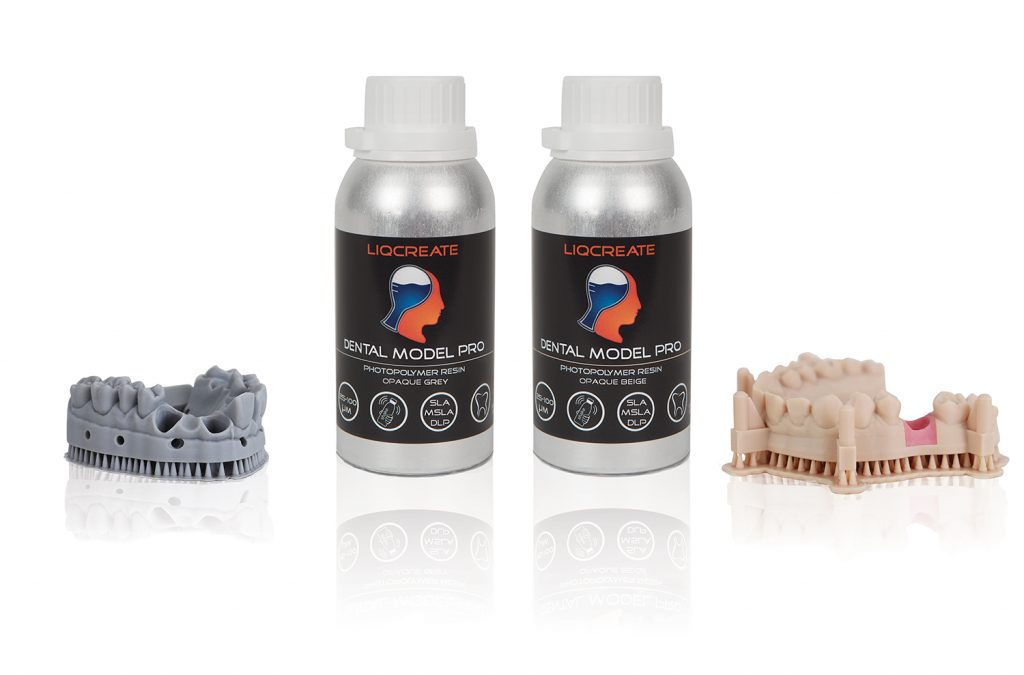
Why dental models warp
Warping is caused by uneven stress distribution during printing, washing or curing. Thin walls, large flat surfaces and unsupported edges are especially sensitive. When stress is not balanced, the part can deform as the resin shrinks or as temperature changes during curing.
Common causes include:
- Large flat bases printed directly on the build plate
- Thin unsupported walls or long unsupported edges
- Uneven curing due to part orientation or curing unit layout
- Residual solvent trapped in internal areas
- Overcuring or excessive curing temperature
For washing and curing guidelines that complement these recommendations, see How to wash and cure dental resins for accuracy.
Design strategies to reduce warping
Good design reduces internal stress and improves dimensional stability. Dental models with balanced wall thickness and reinforced structures are less likely to deform during post processing.
- Avoid extremely thin walls in load bearing or fit critical areas.
- Use chamfers or fillets on sharp edges to distribute stress.
- Reinforce long unsupported spans with ribs or thicker sections.
- Ensure that model bases are not excessively thin or flexible.
For resin specific design considerations, refer to the individual instruction pages in the Dental Resin Instructions hub.
Orientation guidelines for stable dental models
Orientation has a major influence on stress distribution. Printing large flat surfaces directly on the build plate increases the risk of warping because the bottom layers cure under higher compression and shrink differently from upper layers.
- Avoid printing large flat bases directly on the build plate.
- Tilt models slightly to distribute stress across the geometry.
- Orient long edges so they are supported during printing.
- Ensure that critical fit areas are not the first layers printed.
For printer specific settings that complement these orientation strategies, see the Dental 3D printers hub.
Support placement for balanced structural reinforcement
Supports help stabilize the model during printing and reduce deformation. Balanced support placement prevents stress from concentrating in one area.
- Use medium to heavy supports on long edges and thin walls.
- Place supports symmetrically to avoid pulling forces.
- Avoid placing supports directly on margin lines or fit critical areas.
- Use additional supports on overhangs to prevent sagging.
Support strategies should be combined with validated exposure settings from the Dental 3D printers hub and shrinkage values from the Shrinkage Compensation Database.
Post processing steps that minimize warping
Post processing has a significant impact on stability. Incorrect washing or curing can introduce stress that leads to deformation after the part is fully cured.
- Do not leave models submerged in solvent longer than required.
- Ensure complete drying before curing to avoid uneven polymerization.
- Use controlled curing times and avoid excessive heat.
- Rotate parts during curing if the unit does not provide uniform exposure.
For detailed washing and curing recommendations, see How to wash and cure dental resins for accuracy.
Environmental factors that influence warping
Temperature and humidity can affect resin behavior during and after printing. Sudden temperature changes during curing can cause thin sections to deform.
- Use curing units with stable, documented output.
- Avoid curing parts near heat sources or in direct sunlight.
- Store printed models in a stable environment after curing.
Linking warping prevention to accuracy validation
Warping prevention is part of the broader accuracy workflow. When validating accuracy, labs must ensure that design, orientation, supports and post processing are consistent and documented.
To integrate warping prevention into a complete accuracy workflow, combine the recommendations in this article with the protocols in the Printer Accuracy and Calibration hub and the data in the Shrinkage Science hub.
Related dental 3D printing hubs
These hubs provide the broader technical context for integrating washing and curing protocols with material behavior, printer settings, workflow documentation and accuracy validation across the complete dental 3D printing ecosystem.
- Dental 3D printing knowledge center
- Dental resins hub
- Dental resin instructions hub
- Dental 3D printers hub
- Dental workflows hub
Warping can compromise the accuracy and reliability of dental 3D printed models, especially in crown and bridge, implant and aligner workflows. By optimizing design, orientation, support placement and post processing, dental labs can significantly reduce deformation and improve the dimensional stability of printed parts.
This article serves as a reference when defining standard operating procedures for dental model production. Combined with resin specific instructions, printer settings, washing and curing guidelines and shrinkage compensation, these strategies form a robust workflow that delivers consistent, clinically relevant accuracy across multiple printers and indications.
Support
Do you need any help with 3D printing our SLA, DLP or LCD resins? We can help you! Just look for the question you have below. If you can’t find it, let us know by contacting us!
