
Selecting the best castable resin is essential for reliable dental casting workflows in crowns, bridges and partial frameworks. Castable resins must combine clean burnout behavior, stable dimensions and high surface quality to produce metal restorations that fit accurately and require minimal finishing.
This article explains which castable resin is best suited for typical dental lab indications, how it behaves in validated workflows and how it should be combined with printer settings, investment materials and shrinkage data. It is intended as a practical buyer guide for labs that produce burnout patterns for dental casting.
- Overview of castable resin indications and use cases
- Recommended castable resin for crowns, bridges and partial frameworks
- Key properties such as burnout behavior, surface quality and dimensional stability
- Integration with printers, investments and shrinkage compensation
- Links to detailed instructions and comparison guides
For a broader overview of all dental resins, see the Dental resins overview. For indication wide comparison across resin families, see the Resin Comparison and Buyer Guides.
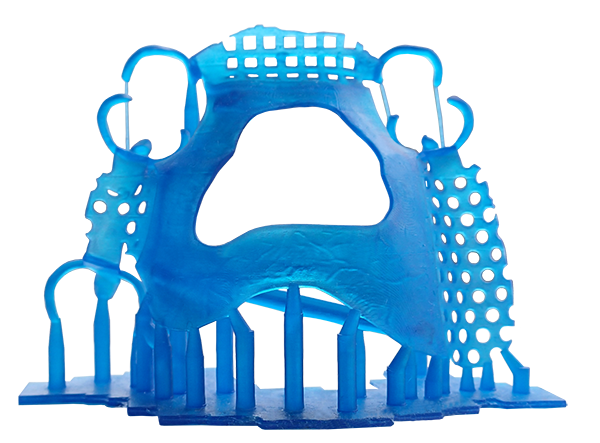
Castable resin indications and use cases
Castable resins are used to print burnout patterns that are invested and cast into metal restorations. They are commonly used for fixed and removable prosthetics where precise fit and clean surfaces are required after casting.
- Crowns and short span bridges in various alloys.
- Long span bridges and multi unit frameworks.
- Partial denture frameworks and other removable structures.
The primary castable material in this context is Wax Castable, a resin designed for clean burnout and high quality casting surfaces. For detailed processing parameters, see the Wax Castable instructions. For indication wide comparison of castable materials, see the Castable resin comparison guide.
Best castable resin for crowns and bridges
Crowns and bridges require accurate margins, stable contacts and smooth surfaces after casting. The castable resin must burn out cleanly without residue and maintain dimensional stability during printing, post processing and burnout.
- Recommended resin: Wax Castable.
- Key reasons: clean burnout behavior, suitable for standard dental investments and high surface quality for crowns and bridges.
- Typical use: single crowns, short and long span bridges and multi unit frameworks in common dental alloys.
For workflows that include design, printing, investing and casting of crowns and bridges, see the relevant protocols in the Dental workflows overview.
Best castable resin for partial frameworks
Partial denture frameworks place additional demands on castable resins due to thin connectors, clasps and complex geometries. The resin must support fine details while still burning out cleanly and maintaining structural integrity during handling.
- Recommended resin: Wax Castable.
- Key reasons: ability to reproduce thin structures, stable handling before investing and reliable burnout for partial frameworks.
- Typical use: removable partial denture frameworks and similar removable structures.
For partial framework workflows that combine CAD design, printing and casting, refer to the applicable protocols in the Dental workflows page and the guidance in the Castable resin comparison guide.
Key properties of castable resins for dental labs
When choosing a castable resin, dental labs should evaluate burnout behavior, surface quality, dimensional stability and handling. These properties determine how predictable the casting process will be and how much finishing is required on the final metal restoration.
- Burnout behavior: clean burnout without residue when used with validated investment and burnout schedules.
- Surface quality: smooth printed surfaces that translate into minimal roughness after casting.
- Dimensional stability: stable dimensions from printing through post processing and burnout.
- Handling: sufficient strength for spruing, investing and transport without deformation or fracture.
For resin specific handling notes and post processing parameters, refer to the Dental resin instructions.
Accuracy, shrinkage and compensation in castable workflows
Accuracy and shrinkage behavior are critical in castable workflows because dimensional changes in the printed pattern and during casting can accumulate. Proper compensation and validation help ensure that the final metal restoration fits as intended.
- Use the shrinkage values and compensation factors documented for Wax Castable and your printer combination.
- Validate accuracy using the protocols in the Printer Accuracy and Calibration overview where applicable.
- Coordinate resin shrinkage with alloy and investment expansion to achieve the desired final dimensions.
For detailed shrinkage data, see the Shrinkage Compensation Database. For general guidance on dimensional behavior in dental 3D printing, see the Shrinkage Science in dental 3D-printing resins.
Integrating castable resins with printers and investments
The best castable resin choice is always made in the context of the available printers, investments and burnout equipment. Printer settings, layer thickness and orientation all influence surface quality and dimensional behavior of the printed patterns.
- Confirm that Wax Castable is validated for your printer family and casting workflow.
- Use the recommended exposure settings from the Dental 3D printers page for castable applications.
- Align printer parameters, investment selection and burnout schedules according to validated workflows.
For printer specific information, see the Dental 3D printers overview and the Printer Accuracy and Calibration article. For complete casting workflows that include Wax Castable, see the Dental workflows page.
Recommended castable resin per dental indication
The list below summarizes the recommended castable resin choice for typical dental lab indications involving metal casting.
- Crowns and short span bridges: Wax Castable as primary choice.
- Long span bridges and multi unit frameworks: Wax Castable with validated shrinkage compensation.
- Partial denture frameworks: Wax Castable for thin structures and complex geometries.
For indication wide comparison of castable materials, see the Castable resin comparison guide. The Best Castable Resin for Dental Labs article is part of the Resin Comparison and Buyer Guides structure. By combining these recommendations with resin specific instructions, validated printer settings, shrinkage data and workflow documentation, dental labs can select the most appropriate castable resin for each indication and build stable, predictable casting workflows.
Support
Do you need any help with 3D printing our SLA, DLP or LCD resins? We can help you! Just look for the question you have below. If you can’t find it, let us know by contacting us!
