
The Phrozen Sonic Mini 4K is a compact MSLA resin 3D‑printer designed for high‑detail reproduction, stable curing behavior and predictable workflow performance. Its 4K LCD panel, fine pixel pitch and consistent irradiance distribution place it in a competitive segment of desktop resin printers aimed at miniature production, engineering prototypes and dental model workflows. This article provides a manufacturer‑grade comparison of the most relevant competitor printers, focusing on optical systems, mechanical stability and curing characteristics that influence real‑world print performance.
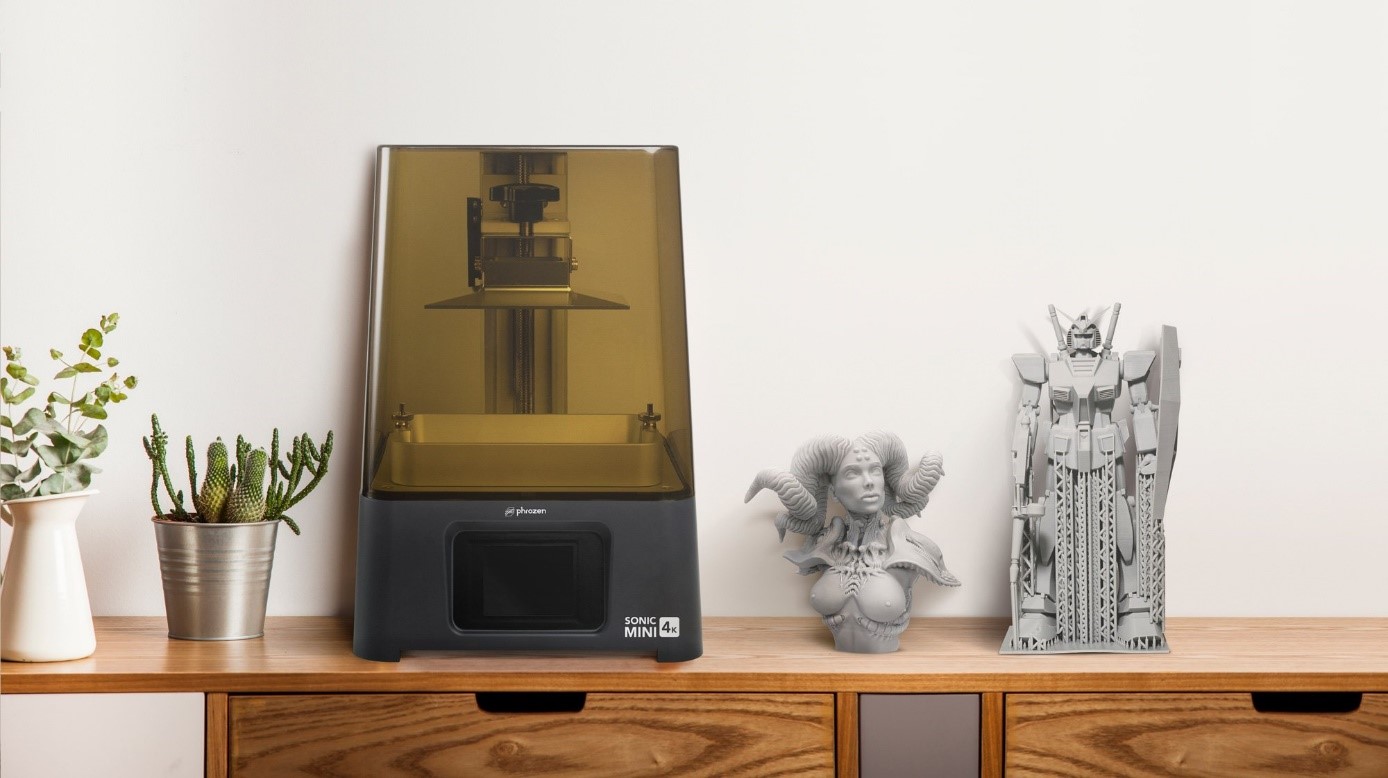
How the Phrozen Sonic Mini 4K fits into the MSLA landscape
The Mini 4K occupies a position between entry‑level MSLA systems and higher‑resolution 6K and 8K platforms. Its 4K LCD panel offers a strong balance of detail and throughput, while the compact build volume supports efficient resin usage and fast layer cycles. Competitor printers in this segment typically share similar LCD sizes, comparable pixel densities and equivalent UV LED arrays, but differ in optical uniformity, mechanical rigidity and firmware behavior. Understanding these differences helps users select the most suitable system for their workflow.
Anycubic Photon Mono 4K
The Anycubic Photon Mono 4K is one of the closest competitors to the Mini 4K in terms of resolution and overall positioning. It uses a 4K monochrome LCD with a similar pixel pitch, making it suitable for miniatures and detailed prototypes. The optical system delivers consistent curing performance, although irradiance uniformity may vary slightly across the panel depending on the specific batch and LED array alignment. Mechanical stability is adequate for most applications, and the printer offers predictable layer formation for standard engineering and hobbyist resins. Users comparing both systems typically evaluate differences in surface finish, exposure consistency and workflow refinement.
Elegoo Mars 3
The Elegoo Mars 3 is another strong competitor in the 4K MSLA category. It features a 4K LCD with a compact pixel pitch and a well‑balanced optical engine that supports fine‑detail reproduction. The Mars 3 is known for its stable mechanical platform and reliable Z‑axis behavior, which contribute to consistent layer stacking and reduced micro‑banding. While its irradiance distribution is generally uniform, the optical system may produce slightly different curing characteristics compared to the Mini 4K, especially when working with engineering‑grade resins. Users often compare the two printers based on surface detail, workflow stability and long‑term reliability.
Creality Halot‑One Plus
The Creality Halot‑One Plus competes with the Mini 4K through its proprietary light engine, which differs from traditional parallel UV LED arrays. This optical system aims to deliver uniform irradiance across the LCD, although real‑world performance varies depending on resin type and exposure settings. The printer’s mechanical structure is robust for its size, and the Z‑axis assembly supports stable layer formation. Compared to the Mini 4K, the Halot‑One Plus may exhibit different curing behavior due to its unique optical configuration, making exposure tuning an important factor for achieving optimal results.
Anycubic Photon Mono X (first‑generation)
The Anycubic Photon Mono X is not a direct 4K competitor in terms of pixel density, but it competes with the Mini 4K on build volume and overall workflow performance. Its larger LCD panel and different pixel pitch result in a different balance between detail and throughput. Users who prioritize build size may consider the Mono X as an alternative, while those focused on fine‑detail reproduction typically prefer the Mini 4K. The optical system of the Mono X provides stable curing behavior, although its larger panel may introduce minor uniformity variations depending on the specific unit.
Choosing between the Mini 4K and its competitors
Selecting the right printer depends on the intended application. The Mini 4K excels in fine‑detail reproduction, stable curing behavior and predictable exposure performance, making it suitable for miniatures, dental models and engineering components. Competitor printers such as the Anycubic Photon Mono 4K, Elegoo Mars 3, Creality Halot‑One Plus and Anycubic Photon Mono X offer alternative balances of resolution, build volume and optical behavior. Users should evaluate differences in pixel pitch, irradiance uniformity, mechanical stability and firmware behavior to determine which system best aligns with their workflow.
Related pages
To support users comparing the Mini 4K with other printers, the following pages provide additional technical context:
→ Phrozen Sonic Mini 4K product page
→ Phrozen Sonic Mini 4K resin settings
→ Phrozen Sonic Mini‑series resin settings
→ Phrozen Sonic Mini‑series cluster page
Support
Do you need any help with 3D printing our SLA, DLP or LCD resins? We can help you! Just look for the question you have below. If you can’t find it, let us know by contacting us!
