
Dental 3D‑printing resins form the foundation of every digital dental workflow. This hub provides a complete technical overview of all Liqcreate materials used for dental models, gingiva masks, castable applications and separation workflows.Each resin includes validated indications, accuracy behavior, printer compatibility and processing parameters to help dental labs achieve predictable and repeatable results across supported printer platforms.
From product‑level specifications to printing instructions, comparison guides and in‑depth resin science, this page serves as the central entry point into all material‑related knowledge for professional dental 3D‑printing.
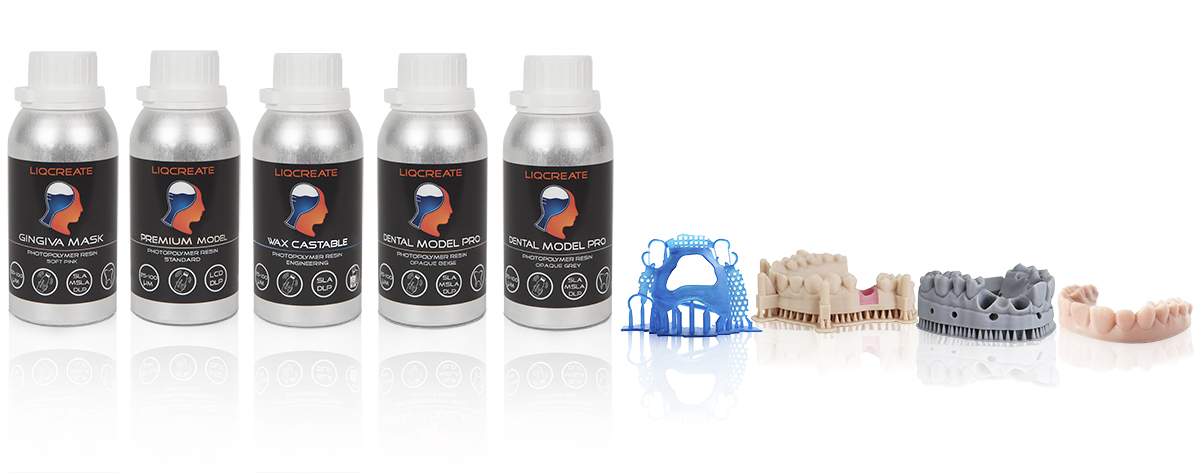
Dental resin product overview
Liqcreate’s dental 3D‑printing portfolio consists of high‑precision resins engineered for dimensional accuracy, thermal and mechanical stability and repeatable performance across LCD, DLP and SLA light engines. Each material page provides validated dental indications, printer‑specific compatibility and fully tested processing parameters, enabling dental labs to achieve predictable results in crown‑and‑bridge models, gingiva masks, castable frameworks and other professional workflows.
- Premium Model
– Quick and economical dental model resin for aligner models and simple cases. - Dental Model Pro Beige
– beige shade dental model resin optimized for visual diagnostics and fit checking for implant and C&B models.
- Dental Model Pro Grey
– grey shade dental model resin for high‑contrast detail and margin visibility for implant and C&B models. - Wax Castable
– castable 3D‑printing resin for dental frameworks. - Gingiva Mask
– soft, flexible resin for simulating gingival tissue around implants and restorations. - Separation Model
– non‑stick separation resin for workflows involving dental acrylics in orthodontics and denture repairs. - Tray
– rigid resin for custom impression trays.
For printer‑specific exposure settings and shrinkage compensation values, refer to the dental 3D‑printers hub and the shrinkage compensation database.
Printing instructions and workflows
Achieving consistent accuracy in dental 3D‑printing depends on correctly calibrated exposure settings, controlled washing and curing, and stable post‑processing procedures. The articles below provide detailed, step‑by‑step instructions for each Liqcreate dental resin, including validated workflows tailored to the requirements of professional dental labs and clinical environments.
Resin‑specific instructions
These resin‑specific instructions provide validated exposure settings, handling steps and post‑processing parameters required to achieve predictable accuracy and repeatable results on supported dental 3D‑printers.
- Instructions for Liqcreate Premium Model
– detailed workflow for printing accurate dental models, including support strategies and curing times. - Instructions for Liqcreate Dental Model Pro
– recommended settings and handling for both beige and grey variants in dental model production. - Instructions for Liqcreate Gingiva Mask
– workflow for printing soft gingival masks and integrating them with implant and prosthetic models. - Instructions for Liqcreate Separation Model
– non‑stick application in combination with dental acrylics and removable appliances. - Instructions for Liqcreate Wax Castable
– printing, investing and burnout recommendations for dental casting workflows. - Instructions for Liqcreate Tray
– printing, handling and post‑curing recommendations for producing rigid custom impression trays and functional dental appliances.
Cross‑resin workflow articles
These cross‑resin workflow articles explain universal processing principles covering washing, curing, orientation and stability—that apply across all Liqcreate dental materials to ensure consistent accuracy in professional dental 3D‑printing workflows.
- How to wash and cure dental resins for accuracy
– best practices for IPA or alternative solvents, curing units and time–temperature combinations. - How to avoid warping in dental models
– design, orientation and post‑processing factors that influence dimensional stability.
For complete end‑to‑end workflows, including scanner, printer and post‑processing integration, see the dental workflows hub.
Resin comparison and buyer guides
Selecting the right resin for each dental indication requires evaluating dimensional accuracy, mechanical performance, color stability, printer compatibility and applicable regulatory standards. The comparison and buyer guides below analyze Liqcreate resins across these technical parameters, helping dental labs choose the most suitable material and streamline their overall resin portfolio.
- Best resin for dental models
– comparison of Premium Model and Dental Model Pro for crown and bridge, aligner and diagnostic models. - Best resin for gingiva masks
– selection criteria for soft tissue simulation around implants and complex restorations. - Best castable resin for dental labs
– evaluation of Wax Castable for frameworks, partials and fine detail casting. - How to choose the right dental resin
– decision framework based on indication, printer type, workflow and regulatory context. - Best Tray resin for dental labs
– decision framework based on tray indication, printer type, workflow requirements and regulatory considerations - Best precision model resin for dental labs
– decision framework based on accuracy requirements, printer technology, model type and laboratory workflow standards - Best implant model resin for dental labs
– decision framework based on implant model accuracy, printer compatibility, dimensional stability and clinical workflow demands - Dental resin buyer’s guide 2026
– strategic overview for labs standardizing on a limited set of resins across multiple printers.
For printer‑specific recommendations, cross‑check these guides with the dental 3D‑printers hub and the dental workflows hub. These comparison resources help dental labs select the most suitable resin for each indication and streamline material choices across different printer platforms.
Resin science and accuracy
Dental applications require tight dimensional tolerances, predictable polymerization shrinkage and stable mechanical behavior across different printer technologies. The articles below explore the underlying resin chemistry and its influence on accuracy, surface quality and long‑term stability in real‑world dental 3D‑printing workflows.
- Resin shrinkage explained
– how polymerization shrinkage occurs and how it interacts with printer settings and compensation. - Dental resin accuracy explained
– factors influencing marginal fit, contact points and occlusal surfaces in printed models. - Exposure calibration for dental accuracy
– how to tune exposure times per printer to balance surface quality and dimensional fidelity. - Resin behavior under different light engines
– performance differences on LCD, DLP and SLA systems and what this means for dental labs. - How resin viscosity affects dental accuracy
– flow, recoating and detail reproduction in fine dental geometries.
For printer‑side validation of accuracy and shrinkage, see the printer accuracy and calibration hub and the shrinkage science hub.
A solid understanding of dental 3D printing resins is essential for achieving predictable accuracy, stable workflows and consistent clinical outcomes. This hub brings together all material knowledge, including product specifications, validated instructions, comparison guides and resin science, so dental labs can standardize their processes and improve overall reliability. Explore the related hubs to integrate materials, printers and workflows into a fully optimized digital dentistry ecosystem.
Support
Do you need any help with 3D printing our SLA, DLP or LCD resins? We can help you! Just look for the question you have below. If you can’t find it, let us know by contacting us!
