
Resin viscosity plays a major role in dental 3D printing accuracy. It influences how the material flows, how layers form, how oxygen is displaced, how polymerization progresses and how dimensional stability is maintained during and after curing. Understanding viscosity behavior is essential for achieving predictable accuracy in restorative, orthodontic and implant applications.
This article is part of the Resin Science and Accuracy structure and explains how viscosity interacts with printer mechanics, light delivery and polymerization behavior. For a complete overview of all dental resins, visit the Dental resins overview. For related scientific topics, see the Resin Science and Accuracy overview.
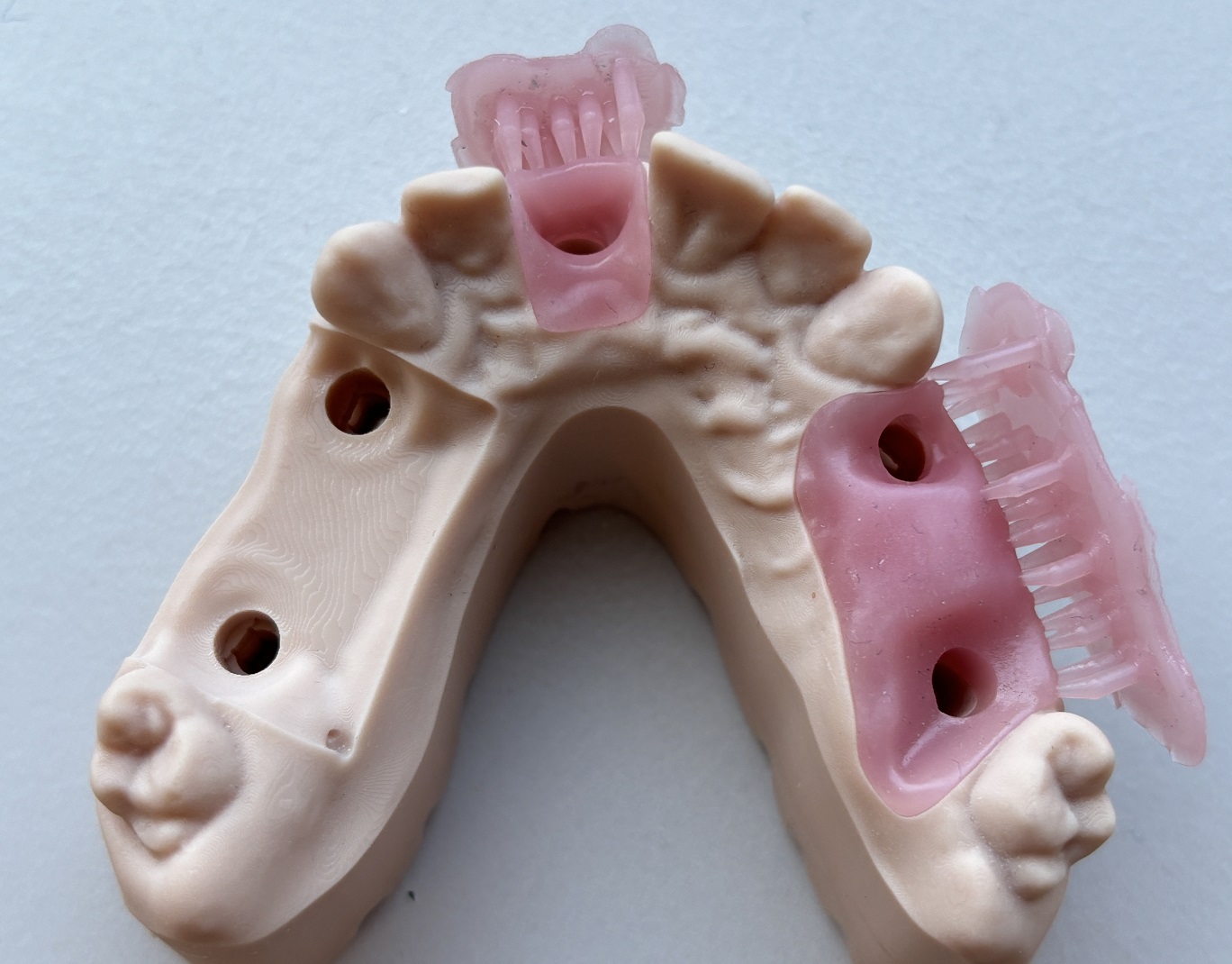
Why viscosity matters for dental accuracy
Viscosity determines how easily the resin flows and how quickly it levels between layers. High viscosity resins behave differently from low viscosity resins in terms of layer formation, detail reproduction and dimensional stability. These differences directly affect margin sharpness, proximal contacts, implant analog fit and aligner model accuracy.
Because dental resins contain pigments, fillers and photoinitiators, viscosity also influences optical behavior, scattering and polymerization uniformity. This makes viscosity a core parameter in resin formulation and printer compatibility.
Flow behavior and layer formation
During printing, the resin must flow back under the build plate after each layer separation. Viscosity determines how quickly this happens and how evenly the resin redistributes. Uneven flow can trap air, create incomplete layers or cause local variations in cure depth.
- Low viscosity resins: flow quickly, level easily and support fine detail reproduction.
- High viscosity resins: flow slowly, may require longer wait times and can influence layer uniformity.
- Filled resins: may show non uniform flow due to particle distribution.
These effects vary by printer mechanics and resin formulation. For resin specific handling and curing parameters, refer to the Dental resin instructions overview.
Viscosity and polymerization behavior
Viscosity influences how monomers and photoinitiators move during polymerization. In low viscosity systems, polymer chains can grow more freely, while in high viscosity systems mobility is restricted. This affects polymerization kinetics, shrinkage behavior and dimensional stability.
- Low viscosity: faster chain mobility, potentially higher shrinkage if not controlled.
- High viscosity: slower mobility, more controlled polymer growth but higher internal stress risk.
- Pigmented systems: viscosity interacts with optical absorption and scattering.
These interactions explain why exposure settings must be calibrated per resin. For calibration guidance, see the Printer Accuracy and Calibration overview.
Impact of viscosity on fine detail accuracy
Fine dental features such as margins, fissures, contact points and implant interfaces require precise resin behavior. Viscosity influences how well the resin fills small cavities and how sharply it reproduces edges.
- Low viscosity: better penetration into small features, improved margin sharpness.
- High viscosity: may struggle to fill narrow geometries, reducing detail accuracy.
- High filler content: can increase viscosity and reduce flow into fine features.
For indication based resin selection aligned with accuracy requirements, refer to the Resin Comparison and Buyer Guides.
Viscosity and printer mechanics
Different printer types interact with resin viscosity in different ways. Peel force, lift speed, vat film elasticity and light engine type all influence how viscosity affects accuracy.
- LCD and MSLA systems: rely on fast resin flow to avoid suction forces and incomplete layers.
- DLP systems: may tolerate higher viscosity due to shorter exposure times and efficient light delivery.
- Printers with flexible vats: may show more sensitivity to high viscosity during layer separation.
For printer specific compatibility and behavior, see the Dental 3D printers overview.
Temperature effects on viscosity and accuracy
Viscosity decreases as temperature increases. Warmer resin flows more easily, levels faster and may improve detail reproduction. However, temperature also affects polymerization kinetics and optical behavior, which can influence accuracy.
- Cold resin: higher viscosity, slower flow, reduced detail accuracy.
- Warm resin: lower viscosity, improved flow but potentially faster polymerization.
- Temperature fluctuations: can cause inconsistent accuracy across prints.
For workflow considerations related to temperature, refer to the Dental workflows page.
Clinical impact of viscosity on dental accuracy
Viscosity influences clinical outcomes by affecting margin fit, contact accuracy, analog seating and aligner model geometry. Low viscosity resins often produce sharper details, while high viscosity resins may offer improved stability for large models but require careful calibration.
Understanding viscosity behavior helps labs choose the correct resin for each indication and optimize printer settings for predictable results.
Resin viscosity influences flow behavior, layer formation, polymerization kinetics, optical interaction and dimensional stability. These factors determine how accurately dental models reproduce clinically relevant features. By understanding viscosity behavior and calibrating settings accordingly, dental labs can achieve consistent accuracy across restorative, orthodontic and implant workflows.
This article is part of the Resin Science and Accuracy structure and connects to the broader calibration and workflow content in the Printer Accuracy and Calibration page , the Dental workflows page and the Dental 3D printers overview.
Support
Do you need any help with 3D printing our SLA, DLP or LCD resins? We can help you! Just look for the question you have below. If you can’t find it, let us know by contacting us!
