
High‑resolution MSLA printers such as the Elegoo Mars 4 and Mars 5 Ultra promise extremely fine detail thanks to their 4K and 12K monochrome LCD panels. In practice, however, the theoretical pixel resolution of the LCD is only one component of the final print fidelity. The optical path, resin chemistry, diffusion behavior, mechanical stability and even the way pixels blend into each other all impose limits that no LCD upgrade can fully overcome. Understanding these constraints is essential for setting realistic expectations, especially when working with engineering parts, dental models or miniature applications where micro‑detail matters.
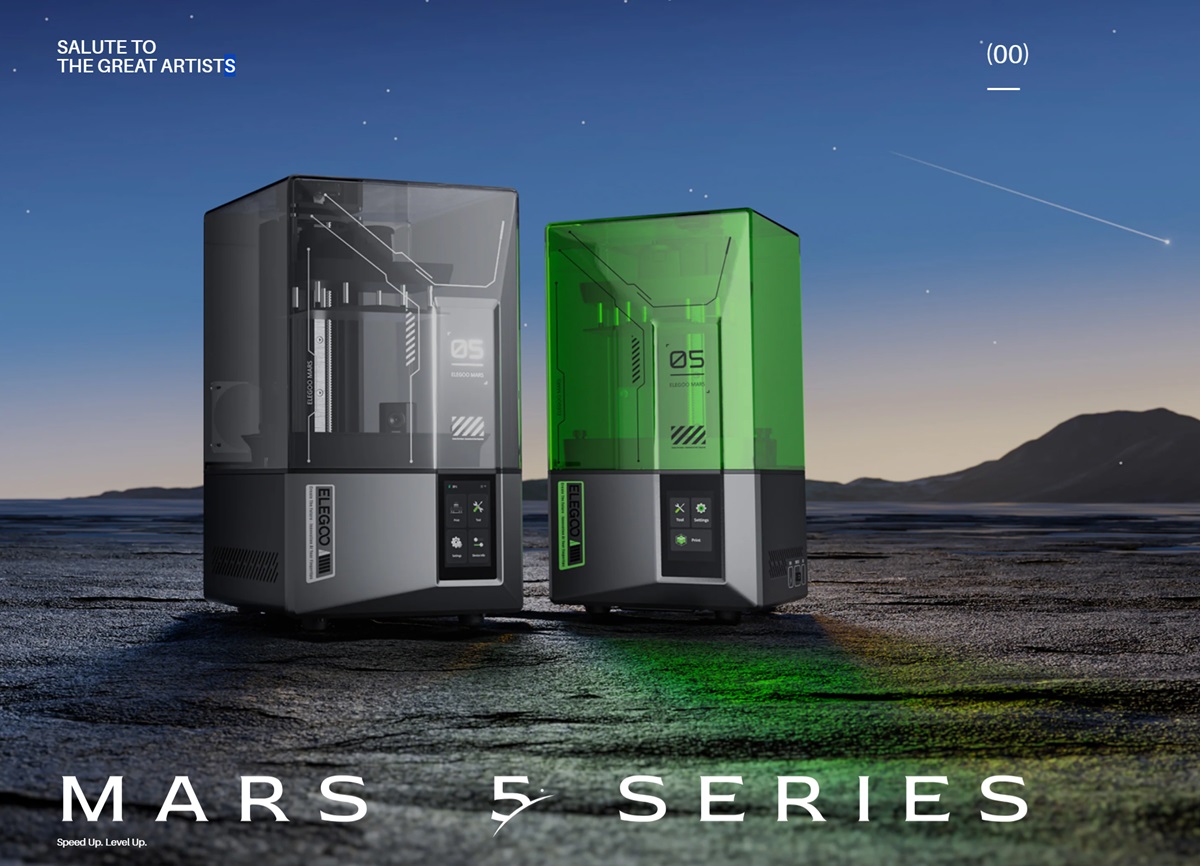
LCD resolution vs. effective detail
Although the Mars 4 and Mars 5 Ultra differ significantly in pixel density, both printers face the same fundamental limitation: the cured voxel is always larger than the physical pixel. Light does not stop at the pixel boundary. It diffuses through the LCD, spreads inside the resin and continues curing beyond the intended geometry. The Mars 5 Ultra’s 12K panel reduces the size of each pixel, but the resin’s optical footprint does not shrink proportionally. As a result, the improvement in real‑world detail is noticeable but not absolute. Ultra‑fine engravings, micro‑textures and sub‑0.1 mm features remain challenging because the resin cannot polymerize with the same precision as the LCD can display.
Optical diffusion and light spread
Even with a well‑collimated LED array, the light passing through the LCD is not perfectly directional. Both printers exhibit a degree of lateral diffusion that softens edges and blends adjacent pixels. The Mars 5 Ultra benefits from a more advanced optical engine, but the underlying physics remain the same: UV light scatters within the resin, especially in pigmented or filled materials. This scattering broadens the cured region and reduces the contrast between fine features. The result is that extremely small details tend to merge, soften or lose definition, regardless of how sharp they appear in the slicer preview.
Resin behavior as the real limiting factor
The resin itself is often the dominant constraint in high‑resolution MSLA printing. Every resin has a characteristic absorption curve and scattering profile that determine how precisely it can cure. Highly pigmented engineering resins, dental model materials and opaque greys or blacks absorb and diffuse light more aggressively, which enlarges the effective curing zone. Even clear resins, which perform better optically, cannot fully match the theoretical resolution of a 12K LCD because polymerization is a volumetric process, not a 2D projection. The chemical reaction continues slightly beyond the illuminated region, softening micro‑features and reducing the sharpness of extremely fine edges.
Mechanical and layer‑based constraints
Mechanical forces during printing also limit achievable resolution. Peel forces can deform thin walls or delicate protrusions, especially on the Mars 4 where the Z‑axis is less rigid than the Mars 5 Ultra. Layer compression, suction forces and micro‑vibrations introduce subtle distortions that accumulate over the height of the print. Even with perfect exposure, these mechanical effects can blur or distort details that are theoretically within the LCD’s capability. The Mars 5 Ultra’s improved mechanics reduce these issues, but they cannot eliminate them entirely.
Where the Mars 4 reaches its limits
The Mars 4 performs well for general‑purpose high‑resolution printing, but its 4K panel and optical engine impose clear boundaries. Fine surface textures, micro‑engraved patterns and extremely small embossed details often lose definition because the pixel pitch is simply too large to represent them cleanly. The printer excels at miniatures, dental arches and functional parts, but it cannot reproduce the ultra‑fine detail that users sometimes expect from a 4K label.
Where the Mars 5 Ultra still encounters limitations
The Mars 5 Ultra’s 12K LCD dramatically increases pixel density, but it does not bypass the optical and chemical realities of MSLA printing. Sub‑pixel grayscale blending, resin scattering and UV bleed‑through still soften the smallest features. The printer delivers noticeably sharper edges and more consistent micro‑details than the Mars 4, yet it remains constrained by the same fundamental physics. True micro‑engraving, ultra‑thin walls and extremely fine textures remain difficult because the resin cannot cure with the same precision as the LCD can display.
Practical expectations for high‑resolution MSLA printing
Both printers deliver excellent detail for their class, but neither can reproduce features at the theoretical limit of their pixel size. Users should expect strong performance on miniatures, dental models and engineering parts, with the Mars 5 Ultra offering visibly cleaner surfaces and finer edges. However, expectations must remain grounded in the realities of resin polymerization, optical diffusion and mechanical stability. High‑resolution MSLA printing is capable of impressive results, but it is not a substitute for technologies designed specifically for micro‑scale accuracy, such as DLP or SLA systems with tightly controlled optical paths.
FAQ
Does a higher LCD resolution guarantee better detail? Not entirely. Higher resolution improves potential detail, but resin scattering and optical diffusion limit real‑world performance.
Why can’t the Mars 5 Ultra reproduce micro‑engraving perfectly? Because sub‑pixel grayscale, resin absorption and UV bleed‑through soften extremely small features.
Is the Mars 5 Ultra better than the Mars 4 for fine details? Yes, but both remain limited by the physics of MSLA curing, not just LCD resolution.
Support
Do you need any help with 3D printing our SLA, DLP or LCD resins? We can help you! Just look for the question you have below. If you can’t find it, let us know by contacting us!
