
Elegoo has been developing MSLA resin 3D printers since 2017, competing with brands like Anycubic and Phrozen in the entry‑level market. The original Elegoo Mars played a key role in establishing Elegoo’s position by offering affordable resin printing at a time when most competitors were still focused on higher‑priced systems. As one of the most widely adopted budget resin printers, the Mars series helped define accessible desktop MSLA technology. This page provides a technical overview of the original Elegoo Mars, its optical system, print performance and typical use cases within resin‑based workflows. Its long market presence ensures broad resin compatibility and stable curing behavior across most 405 nm photopolymers.
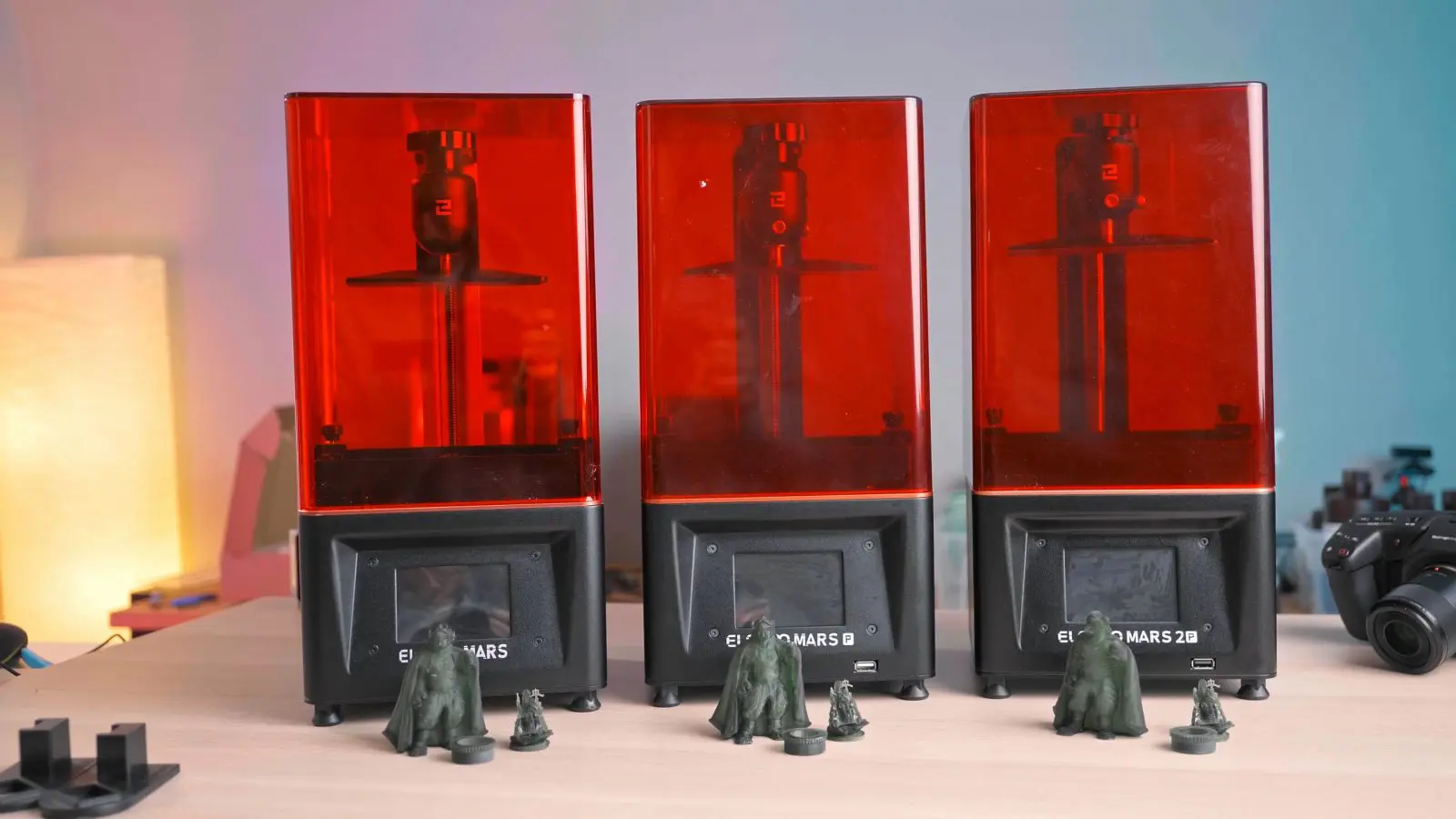
Generational context within the Elegoo Mars‑series
The original Elegoo Mars belongs to the first generation of MSLA printers using a 2K RGB LCD. Later models such as the Mars 2, Mars 2 Pro and Mars 3 introduced monochrome LCDs, faster curing speeds and improved pixel density. This makes the original Mars slower, but still predictable and widely compatible with 405 nm photopolymers.
Elegoo Mars technical comparison table
The table below summarizes the core hardware specifications of the original Elegoo Mars and places it in context with later models in the Mars‑series. These parameters highlight the differences in LCD technology, pixel density, build volume and optical performance that influence curing behavior, print speed and overall MSLA workflow stability. This comparison helps position the original Mars within the broader Elegoo lineup and clarifies how it relates to newer printers such as the Mars 2, Mars 2 Pro and Mars 3.
| Specification | Elegoo Mars (Original) | Mars 2 | Mars 2 Pro | Mars 3 |
|---|---|---|---|---|
| LCD type | 2K RGB LCD | 2K Monochrome | 2K Monochrome | 4K Monochrome |
| Pixel size | 47 µm | 50 µm | 50 µm | 35 µm |
| Build volume (mm) | 120 × 68 × 155 | 129 × 80 × 150 | 129 × 80 × 160 | 143 × 89 × 175 |
| Print speed | 22–30 mm/h | 30–50 mm/h | 30–50 mm/h | 30–50 mm/h |
| Z‑axis | Single linear rail | Single | Single | Single |
| Light source | UV LED array | UV LED array | UV LED array | COB + Fresnel |
| Resin compatibility | 405 nm photopolymers | 405 nm | 405 nm | 405 nm |
| LCD lifetime | Low | Medium | Medium | High |
Optical system and LCD characteristics
The Elegoo Mars uses a 2K RGB LCD as its masking screen, paired with a basic UV LED array. While modern printers use monochrome LCDs for faster curing, the Mars still delivers consistent results for small parts, miniatures and general prototyping. The RGB panel produces lower irradiance compared to newer models, which means exposure times are longer but predictable.
Key optical characteristics include:
- – 2K RGB LCD with moderate pixel density
- – 405 nm UV LED array with uniform but lower irradiance
- – Standard MSLA light path without collimation
- – XY resolution suitable for entry‑level detail
These specifications make the Mars suitable for users who prioritize predictable MSLA performance and consistent curing over ultra‑high‑resolution output.
Print performance and dimensional accuracy
Despite its older LCD technology, the Elegoo Mars maintains stable curing behavior and predictable dimensional accuracy when paired with well‑tuned resin settings. The printer performs best with:
- – standard engineering‑grade photopolymers
- – dental model resins
- – miniature and figurine materials
- – general‑purpose photopolymers
The Mars is less suited for:
- ultra‑rigid resins
- high‑viscosity engineering blends
- ultra‑high‑resolution applications requiring 4K–12K LCDs
However, for its class, the Mars offers excellent value and consistent print quality.
Build volume and mechanical design
The Elegoo Mars features a compact build volume that suits most hobbyist and prototyping applications:
- Build volume: 120 × 68 × 155 mm
- Z‑axis: single linear rail
- Vat: standard FEP‑based resin vat
- Platform: sandblasted aluminum plate for reliable adhesion
The compact build volume also reduces peel forces, which contributes to stable print behavior on entry‑level MSLA systems. The mechanical design is simple, stable and easy to maintain, which is one of the reasons the Mars remains popular among beginners.
Workflow and user experience
The Mars is designed for straightforward operation:
- – simple leveling procedure
- – predictable exposure behavior
- – wide resin compatibility
- – minimal maintenance requirements
The Mars workflow is especially suitable for users who prefer predictable curing behavior without extensive parameter tuning. Its slower exposure times compared to monochrome LCD printers are offset by its reliability and ease of use.
Resin compatibility and exposure behavior
The Elegoo Mars works with a wide range of 405 nm photopolymer resins. Because of its RGB LCD, exposure times are typically longer than on newer Mars models. Users should expect:
- longer base layer exposures
- slightly increased normal layer exposure times
- stable cure depth across the build area due to uniform but lower irradiance
For detailed, printer‑specific exposure parameters, see the validated Liqcreate resin settings for the Elegoo Mars.
When to choose the Elegoo Mars
The Elegoo Mars is a strong choice if you need:
- – an affordable entry‑level MSLA printer
- – consistent print quality without advanced tuning
- – compatibility with a wide range of resins
- – a compact machine for small‑scale production or hobby use
It is less suitable if you require:
- – ultra‑high resolution (4K–12K)
- – fast curing speeds
- – advanced optical systems (collimated light, COB LEDs)
How the Elegoo Mars compares to newer models
Compared to the Mars 2 and Mars 2 Pro, the original Mars uses an older 2K RGB LCD, resulting in slower curing speeds but predictable exposure behavior. Newer models such as the Mars 3 and Mars 4 Ultra offer higher resolution, faster print speeds and improved optical systems, but the original Mars remains a stable and widely compatible entry‑level option.
Related technical resources
These pages provide deeper context for exposure tuning, resin behavior and model‑specific performance within the Elegoo Mars‑series:
- – Elegoo Mars resin settings
- – Elegoo Mars‑Series resin 3D‑printer cluster
- – Elegoo Mars 2 / Mars 2 Pro resin settings
- – Elegoo Mars 3 resin settings
- – Elegoo Mars 4 and Mars 4 Ultra resin settings
- – Elegoo Mars exposure tuning overview
Support and workflow optimization
For detailed exposure parameters, resin compatibility and workflow guidance, visit the Liqcreate resin setting database or contact engineering support for model‑specific recommendations.
Support
Do you need any help with 3D printing our SLA, DLP or LCD resins? We can help you! Just look for the question you have below. If you can’t find it, let us know by contacting us!
