
Printer resolution plays a fundamental role in how optical energy is delivered into resin during layer curing, shaping polymerization uniformity, curing depth and contraction behavior across dental models. Higher resolution engines generate smaller pixel or voxel structures that concentrate energy more precisely, while lower resolution systems distribute energy across larger optical units that may introduce diffusion, falloff or localized curing variation. These resolution driven differences influence how resin transitions from a liquid to a solid network, determining how contraction develops horizontally and vertically across reference geometries printed under standardized conditions.
Understanding how printer resolution affects shrinkage allows dental laboratories to evaluate dimensional behavior across different light engine types, exposure strategies and resin combinations. Fine voxel structures can improve curing consistency when mechanical stability and exposure calibration are controlled, while coarse pixel structures may amplify optical inconsistencies or mechanical drift that influence contraction magnitude. Resolution interacts directly with resin polymerization kinetics and environmental stability, meaning that shrinkage patterns must be validated through repeated prints across multiple build plate positions and orientations to confirm predictable dimensional outcomes.
Printer resolution is an important indicator for dimensional accuracy and shrinkage behavior, but it is only one of several factors that influence how contraction develops in dental 3D‑printing. Each printer platform, light engine type and resin system requires its own controlled shrinkage measurement and optimization routine to ensure predictable geometry. When a manufacturer builds uniform hardware with consistent optical and mechanical performance, shrinkage data can be transferred one‑to‑one across identical units of the same model. New printer models or new light engine technologies require fresh shrinkage testing and optimization to establish accurate compensation values and maintain reliable dimensional outcomes.
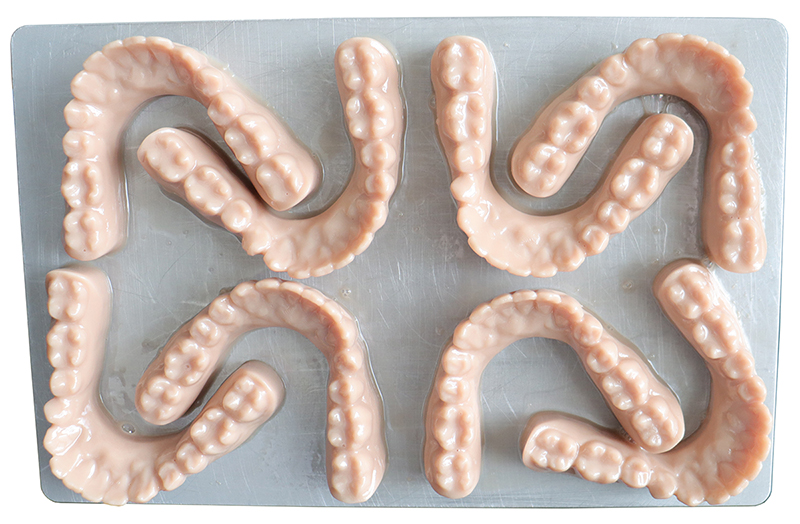
Ecosystem Behavior
Resolution driven shrinkage develops within a controlled dental printing ecosystem where resin chemistry, environmental stability and mechanical performance interact. Temperature, humidity and resin aging influence viscosity and curing kinetics, affecting how contraction forms across fine voxel structures. Stable environmental conditions ensure predictable shrinkage behavior across daily production workflows.
Light Engine Behavior
Light engine characteristics determine how pixel or voxel energy distribution affects horizontal contraction. High resolution engines produce smaller pixel structures that reduce optical diffusion and improve curing uniformity when paired with validated exposure settings. Lower resolution engines may exhibit optical falloff or diffuser inconsistencies that create localized shrinkage patterns across the build plate. Reference geometries printed at multiple positions validate how resolution influences optical uniformity.
Mechanical Stability
Mechanical systems influence how resolution driven shrinkage appears in vertical dimensions. Z axis rigidity, lift mechanics and platform alignment determine how accurately layers stack when cured with fine voxel structures. Mechanical drift or inconsistent lift speeds can amplify vertical contraction tendencies, especially in high resolution systems where layer thickness is tightly controlled. Height controlled reference prints reveal how mechanical performance interacts with resolution during shrinkage development.
Resin Interaction
Resin polymerization behavior determines how different materials respond to resolution specific curing. High viscosity resins may require adjusted exposure settings to maintain curing consistency across fine pixel structures, while low viscosity resins may exhibit different contraction tendencies under high resolution curing. Controlled reference prints quantify resin dependent shrinkage patterns and reveal how polymerization behavior changes with resolution.
Exposure Strategy
Exposure strategy determines how resolution affects curing consistency and contraction magnitude. High resolution engines often require precise exposure tuning to avoid over curing or under curing across fine voxel structures. Over curing increases horizontal expansion before contraction, while under curing leads to weak features and vertical drift. Validated exposure settings ensure that shrinkage reflects true resin and printer behavior rather than exposure errors. See Exposure Calibration for Dental Accuracy.
Accuracy Behavior
Accuracy behavior describes how resolution influences dimensional outcomes during controlled model production. Horizontal and vertical contraction tendencies are evaluated by comparing printed reference geometries to intended CAD dimensions. High resolution engines may produce more consistent dimensional behavior when exposure and mechanical performance are stable. Accuracy behavior is validated through repeated prints across different build orientations. See Best Practices for Dimensional Accuracy.
Calibration Routines
Calibration routines quantify resolution driven shrinkage by printing standardized reference geometries and measuring deviation from intended CAD dimensions. Each printer model receives its own shrinkage profile based on its resolution, light engine behavior, mechanical stability and resin interaction. These profiles guide compensation workflows and exposure tuning. Deviations caused by incorrect exposure, resin aging or mechanical drift require recalibration to maintain reliable shrinkage characterization. See How Shrinkage Compensation Works.
Troubleshooting Patterns
Troubleshooting resolution driven shrinkage involves identifying deviations caused by pixel edge softening, optical falloff or inconsistent curing across fine voxel structures. Horizontal contraction may indicate diffuser inconsistencies or over curing, while vertical drift suggests mechanical instability or lift behavior variation. Consistent troubleshooting ensures predictable shrinkage behavior across daily production workflows. See How to Test Shrinkage in Dental Models.
Workflow Integration
Resolution driven shrinkage integrates directly into dental model production workflows by informing compensation values and exposure tuning. Understanding how printer resolution affects shrinkage ensures that final cured geometries align with intended CAD dimensions and maintain seating accuracy for Dental Model Production, Implant Models and Orthodontic Models. Stable exposure calibration and mechanical validation support consistent fit, seating accuracy and repeatability across different printer platforms.
Support
Do you need any help with 3D printing our SLA, DLP or LCD resins? We can help you! Just look for the question you have below. If you can’t find it, let us know by contacting us!
