
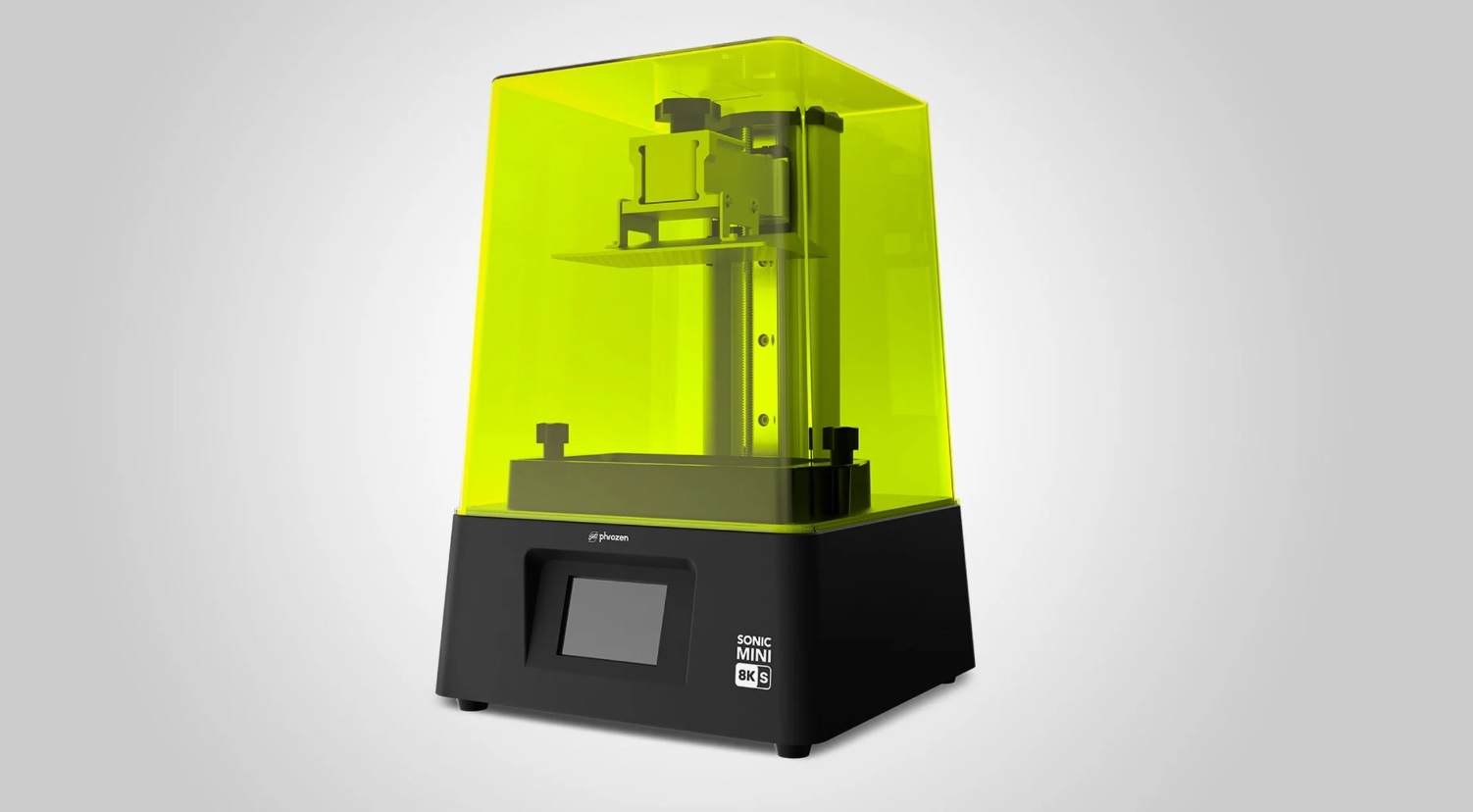
The Phrozen Sonic Mini 8K S is a compact high‑resolution MSLA printer built around a 7.1” 8K monochrome LCD with a 22 µm pixel size and a stable linear‑rail Z‑axis. This combination allows the printer to reproduce extremely fine surface textures, sharp edges, and accurate geometries, provided that the resin used is compatible with high‑intensity 405 nm light engines. For a full technical overview of the hardware and specifications, users can refer to the Phrozen Sonic Mini 8K S product page, while this article focuses specifically on resin compatibility and material behavior.
Liqcreate resins are formulated for 405 nm MSLA systems and perform exceptionally well on the Mini 8K S when exposure times and lift settings are tuned correctly. This page provides a complete overview of compatible materials and the considerations that matter for consistent, accurate printing.
Liqcreate resin compatibility for the Mini 8K S
All Liqcreate 405 nm photopolymers are technically compatible with the Mini 8K S. The printer’s strong light output means that most materials cure faster than on 4K‑class machines, so exposure times tend to be shorter and bottom layers require careful balancing. Once dialed in, the Mini 8K S produces crisp details, stable layer adhesion, and excellent dimensional accuracy across the full range of Liqcreate resins.
Users who operate multiple printers in the same workflow can compare the Mini 8K S compatibility with other models in the series by consulting the Phrozen Sonic Mini Series resin compatibility overview, which provides a broader, series‑wide perspective on material behavior.
Standard and engineering resins
Premium Model is the most widely used resin on the Mini 8K S thanks to its low viscosity and ability to capture extremely fine details. It flows easily, cures predictably, and is suitable for miniatures, prototypes, and general‑purpose parts. Premium Tough is a better choice when impact resistance is required, for example in housings or functional components that undergo mechanical stress. Premium Flex also prints reliably, although flexible materials benefit from slightly longer bottom exposure to ensure proper adhesion and to prevent early‑layer tearing.
For high‑strength applications, Strong‑X offers excellent stiffness and low shrinkage, making it suitable for functional prototypes and engineering parts that require dimensional stability. Clear Impact is the preferred option when transparency or visual inspection of internal channels is important. It prints cleanly on the Mini 8K S but requires extended post‑curing to achieve full optical clarity, especially in thicker sections.
Dental resins
The Mini 8K S performs exceptionally well with dental model materials. Dental Model Pro Beige and Grey both deliver high dimensional accuracy and stable curing behavior, which is essential for orthodontic models, aligner workflows, and diagnostic applications. Their matte surfaces also improve scanability, making them suitable for digital dentistry workflows. Gingiva Mask is fully compatible as well and can be combined with Model Pro resins to create implant models with realistic soft‑tissue simulation.
Special purpose resins
Composite‑X is a high‑modulus engineering resin that benefits from the Mini 8K S’s precise motion system. It produces stiff, thin‑wall parts with excellent dimensional stability, provided that lift speeds are tuned conservatively. Hazard Glow also prints well on this machine; its glow‑in‑the‑dark pigments require slightly longer exposure times, but the resin remains stable and predictable on 8K‑class printers.
Resins that require tuning
Some materials need more careful parameter adjustment due to viscosity, pigment load, or mechanical behavior. Flexible‑X benefits from longer cooling times between layers to maintain consistent geometry. Elastomer‑X requires low lift speeds to prevent layer distortion. Deep Blue needs a stronger bottom exposure to ensure proper adhesion, while Stone Coal Black, being pigment‑rich, responds best to slightly longer exposure times. For precise exposure values, lift speeds, and bottom layer settings, users should refer to Phrozen Sonic Mini 8K S Resin Parameters, where printer‑specific settings are documented in detail.
Unsupported or not recommended
Ultra‑high‑viscosity resins are not ideal for the Mini 8K S because they do not flow quickly enough for the printer’s fine pixel pitch. Metal‑filled or ceramic‑filled resins are also unsuitable due to sedimentation and excessive wear. Any resin outside the 405 nm UV spectrum should be avoided entirely, as it will not cure reliably on the Mini 8K S light engine.
FAQ
What is the best Liqcreate resin for the Mini 8K S? The best resin depends on the application. Premium Model is the most versatile option for general printing and detailed models. Strong‑X and Composite‑X are preferred for functional engineering parts that require stiffness and strength, while Dental Model Pro is the best choice for dental applications. For a focused overview of material selection, users can consult Best Liqcreate resin for Phrozen Sonic Mini 8K S, which compares the most relevant resins by use case.
Can the Mini 8K S print flexible resins? Yes. Premium Flex and Gingiva Mask both print reliably on this machine. Lower lift speeds help maintain layer stability and prevent tearing during the early layers, especially on tall or thin‑walled flexible parts.
Why do exposure times differ between 8K printers? Differences in LCD transmission, LED intensity, and pixel pitch influence how quickly a resin cures. The Mini 8K S has a strong light engine, which results in shorter exposure times compared to many other printers. When switching from another 8K or 4K system, it is normal to reduce exposure times and re‑validate support strategies.
Support
Do you need any help with 3D printing our SLA, DLP or LCD resins? We can help you! Just look for the question you have below. If you can’t find it, let us know by contacting us!
