
The Phrozen Sonic Mini 8K S is the cost‑optimized evolution of the original Sonic Mini 8K, designed to deliver ultra‑high‑resolution MSLA printing in a compact and accessible format. It retains the same 22‑micron XY resolution and 8K monochrome LCD, but introduces a simplified single‑rail Z‑axis and a revised optical engine that improves light uniformity while reducing overall system complexity. This combination makes the Mini 8K S a capable desktop resin 3D‑printer for users who require fine surface detail, dimensional accuracy and stable workflow performance without moving to larger or more advanced platforms.
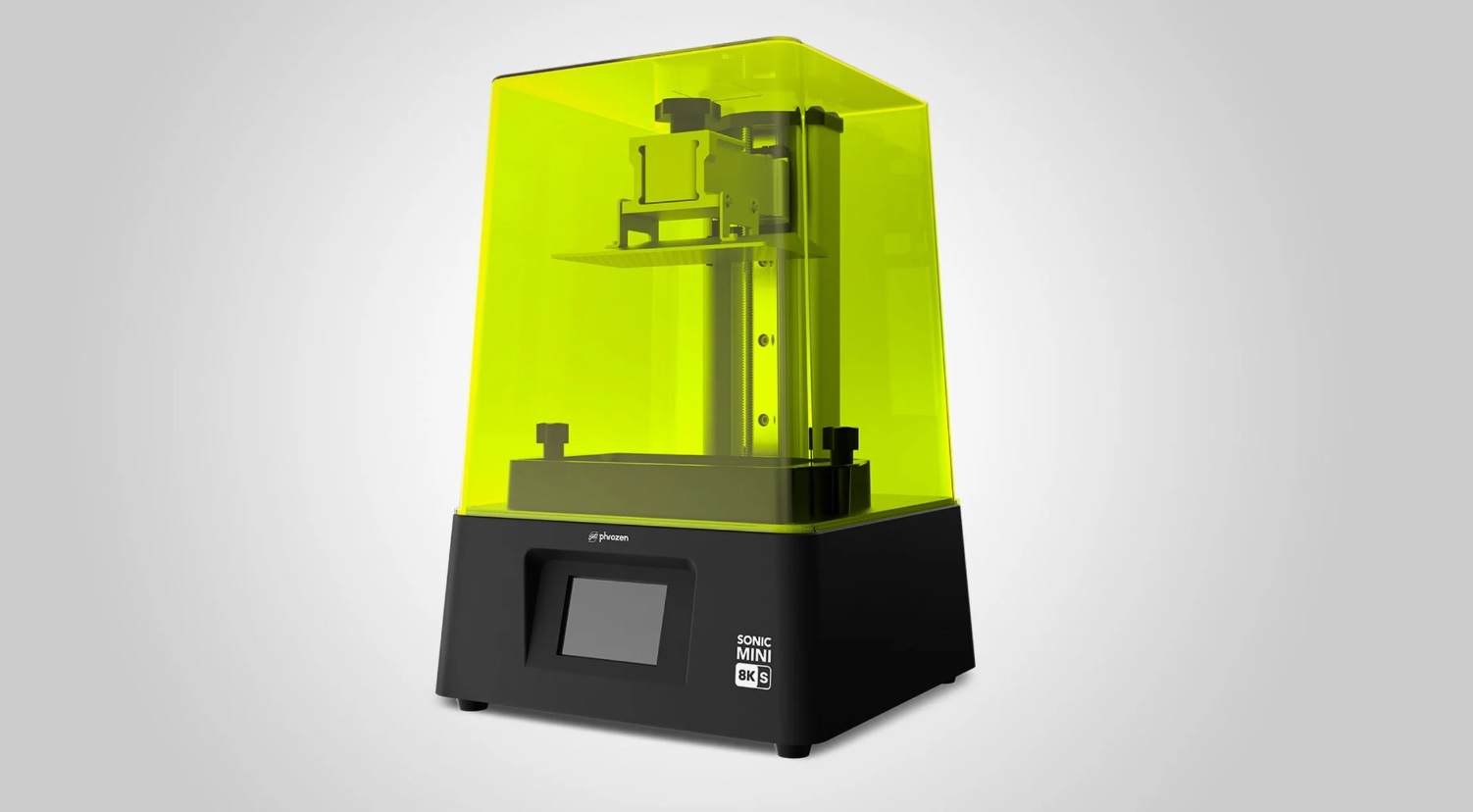
Phrozen Sonic Mini 8K S technical specifications
The specifications of the Sonic Mini 8K S outline a compact MSLA system built for precision rather than volume. Its 8K LCD, controlled optical path and single‑rail mechanics work together to create a stable curing environment that supports detailed resin workflows. The hardware configuration defines how the printer handles exposure depth, layer consistency and surface reproduction, and forms the technical basis for its performance across different Liqcreate materials.
| Specification | Phrozen Sonic Mini 8K S |
| LCD type | 7.1‑inch 8K monochrome LCD |
| XY resolution | 22 microns |
| Pixel resolution | 7680 × 3240 |
| Build volume (L × W × H) | 165 × 72 × 170 mm |
| Light source | High‑uniformity LED with 90° optical path |
| Z‑axis | Single linear rail |
| Slicer compatibility | VoxelDance Tango |
| Resin wavelength | 405 nm photopolymer |
| Printer type | MSLA resin 3D‑printer |
Optical system and LCD performance
At the core of the Mini 8K S is a 7.1‑inch 8K monochrome LCD with high UV transmission and fast exposure characteristics. The panel produces extremely fine pixel definition, allowing curved surfaces, micro‑textures and small geometric features to appear with minimal visible pixelation. Beneath the LCD, Phrozen uses a redesigned LED module that projects light onto a mirror before it reaches the screen. This indirect optical path distributes light more evenly across the build plate, reducing hotspots and improving curing consistency across the entire print area. Although the system remains MSLA‑based, the optical layout resembles the uniformity strategies used in DLP systems, resulting in highly consistent layer formation.
Mechanical structure and Z‑axis behavior
The Mini 8K S differs from the original Mini 8K through its single‑rail Z‑axis. While the earlier model uses a dual‑rail configuration, the simplified structure of the Mini 8K S reduces weight and manufacturing complexity. The carriage block and motion components have been reinforced to maintain stability during peeling, and the printer’s overall rigidity is sufficient for most resin types, including dental, engineering and miniature‑oriented materials. In practice, the single‑rail design introduces subtle differences in peel behavior, particularly when working with flexible, high‑viscosity or heavily pigmented resins. These differences do not reduce print quality but may require minor adjustments in exposure time or support density when compared to the original Mini 8K.
Print quality and real‑world performance
The 22‑micron XY resolution allows the Mini 8K S to reproduce micro‑features with exceptional clarity. Early sample prints show nearly invisible pixelation on curved surfaces, and fine textures such as skin pores, miniature armor patterns and dental fissures are reproduced with high fidelity. Real‑world performance depends not only on hardware but also on resin formulation, exposure tuning and workflow stability. Users working with engineering‑grade materials or flexible resins will benefit from careful calibration to ensure consistent curing depth and dimensional accuracy. The printer’s compact build volume of 165 × 72 × 170 mm supports a wide range of applications, from dental arches and aligner models to small engineering components and detailed figurines.
Workflow behavior and exposure tuning
The Sonic Mini 8K S shows a characteristic exposure behavior that differs slightly from the original Mini 8K due to its single‑rail mechanics and revised optical engine. The printer cures consistently across the build plate, but the reduced rigidity of the Z‑axis can influence peel dynamics when working with flexible, high‑viscosity or heavily pigmented materials. These effects are subtle yet relevant for users printing engineering‑grade or elastomeric resins, where small variations in peel force can affect layer adhesion and dimensional stability. Achieving optimal results requires careful tuning of exposure time, lift speed and support geometry, especially when printing tall or thin structures. Once calibrated, the Mini 8K S delivers stable curing behavior and predictable performance across a wide range of Liqcreate materials.
Pricing and market position
The Phrozen Sonic Mini 8K S launched at an introductory price of approximately 349.99 USD, with an expected retail price near 599.99 USD depending on region and availability. This positions the printer below the original Mini 8K while maintaining comparable optical performance, making it an attractive option for users who prioritize detail quality over maximum mechanical rigidity. Its combination of high resolution, compact size and simplified mechanics makes it suitable for both professional and enthusiast environments.
Compatibility with Liqcreate resins
The Mini 8K S performs well with the majority of Liqcreate materials. Several resins have already been validated with dedicated exposure parameters, and additional profiles will be published as more testing data becomes available. The printer’s high‑resolution LCD and uniform optical engine allow it to handle both standard and engineering‑grade resins, although flexible and elastomeric materials may require heavier supports due to the single‑rail Z‑axis. Users can refer to the Phrozen Sonic Mini 8K S resin settings page for the most accurate and up‑to‑date exposure values. Based on Liqcreate’s experience with previous Phrozen systems and other 405 nm MSLA printers, the full resin portfolio is expected to be compatible.
For updates or compatibility questions, contact info@liqcreate.com. Team Liqcreate wishes all early users successful printing with the Phrozen Sonic Mini 8K S. For questions, feedback or resin compatibility support, feel free to contact us at any time.
→ Back to the Phrozen Sonic Mini‑series resin 3D‑printer cluster
Support
Do you need any help with 3D printing our SLA, DLP or LCD resins? We can help you! Just look for the question you have below. If you can’t find it, let us know by contacting us!
