
Shrinkage testing evaluates how dental 3D‑printed models contract during printing and post curing by measuring controlled reference geometries under standardized conditions. This article explains how shrinkage develops, how it is quantified and how resin behavior, light engine characteristics and mechanical stability influence dimensional outcomes across validated printer and resin combinations.
Ecosystem Behavior
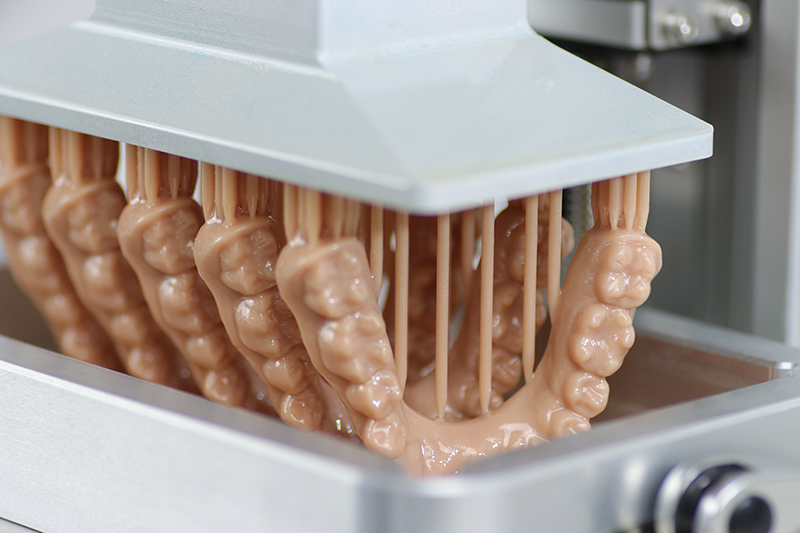
Shrinkage testing operates within a controlled dental printing ecosystem where resin chemistry, light exposure and mechanical performance interact to produce predictable dimensional tendencies. Testing procedures rely on stable environmental conditions, consistent resin handling and validated exposure settings to ensure that measured contraction reflects true material and printer behavior rather than external variability. Reference geometries printed under standardized conditions reveal how contraction develops across different model types, build orientations and positions on the build plate. These measurements form the basis for evaluating shrinkage behavior and validating compensation workflows.
Light Engine Behavior
Light engines influence shrinkage testing through pixel or voxel energy distribution. Uniformity across the build plane determines how evenly layers cure, affecting horizontal contraction. Shrinkage tests printed at multiple positions reveal localized expansion or contraction caused by optical falloff, diffuser inconsistencies or LED intensity variation. High resolution engines produce finer voxel structures that can reduce horizontal distortion when paired with stable exposure settings. Shrinkage testing quantifies these tendencies by comparing measured dimensions across controlled reference prints.
Mechanical Stability
Mechanical systems contribute to shrinkage behavior through Z axis rigidity, platform movement and lift mechanics. Any variation in vertical movement can influence layer stacking accuracy and vertical contraction. Shrinkage tests using height‑controlled geometries reveal mechanical drift, backlash or inconsistent lift speeds that affect dimensional stability. Stable mechanical performance ensures that shrinkage measurements remain valid over time. Deviations caused by mechanical instability require recalibration before shrinkage testing can produce reliable results.
Resin Interaction
Resin polymerization drives contraction as monomers cross link into a solid network. Shrinkage testing incorporates resin specific behavior by measuring polymerization kinetics, viscosity behavior and curing depth. Controlled reference prints reveal how different resins contract during printing and post curing, allowing laboratories to quantify resin dependent shrinkage patterns. High viscosity materials may exhibit different contraction tendencies than low viscosity materials, requiring resin specific testing to ensure accurate dimensional evaluation.
Exposure Strategy
Exposure strategy determines how consistently layers cure and how contraction develops across the model. Layer exposure time, lift speeds and curing profiles influence cross layer consistency and dimensional stability. Shrinkage testing relies on validated exposure settings to ensure that measured contraction reflects true resin behavior rather than exposure errors. Incorrect exposure settings can cause over curing or under curing, leading to dimensional drift that affects shrinkage measurements. Exposure strategy must be validated before shrinkage testing begins.
Accuracy Behavior
Accuracy behavior describes how predictable contraction patterns develop during controlled model production. Shrinkage testing evaluates these patterns by comparing printed reference geometries to intended CAD dimensions. This reveals horizontal and vertical contraction tendencies that influence seating accuracy for dies, implant analog models and orthodontic appliances. Accuracy behavior is validated through repeated shrinkage tests to confirm that contraction patterns remain stable across different build orientations and model types.
Calibration Routines
Calibration routines generate shrinkage measurement values by printing standardized reference geometries and measuring dimensional deviation. These routines operate under controlled conditions to ensure neutral and repeatable results. Each printer model receives its own shrinkage profile based on its light engine behavior, mechanical stability and resin interaction. Calibration routines also validate exposure strategy and mechanical performance. Deviations caused by incorrect exposure, resin aging or mechanical drift require recalibration to maintain reliable shrinkage testing.
Troubleshooting Patterns
Troubleshooting shrinkage testing involves identifying deviations caused by exposure errors, resin handling issues or mechanical instability. Over curing can cause horizontal expansion, while under curing can increase contraction. Resin aging may alter polymerization behavior, affecting shrinkage measurements. Mechanical drift can introduce vertical dimensional errors that require recalibration. Consistent troubleshooting ensures that shrinkage testing remains accurate and that dimensional behavior is correctly characterized across daily production workflows.
Workflow Integration
Shrinkage testing integrates directly into dental model production workflows by validating dimensional behavior before compensation values are applied. This ensures that the final cured model aligns with intended CAD dimensions, maintaining seating accuracy for dies, implant analog models and orthodontic appliances.
Shrinkage testing supports downstream workflows such as Dental Model Production, Implant Models and Orthodontic Models by providing predictable dimensional baselines for resin specific and printer specific behavior. By combining shrinkage testing with stable exposure calibration, dental labs maintain consistent fit, seating accuracy and repeatability across different printer platforms, ensuring reliable daily production.
Support
Do you need any help with 3D printing our SLA, DLP or LCD resins? We can help you! Just look for the question you have below. If you can’t find it, let us know by contacting us!
